Key ideas
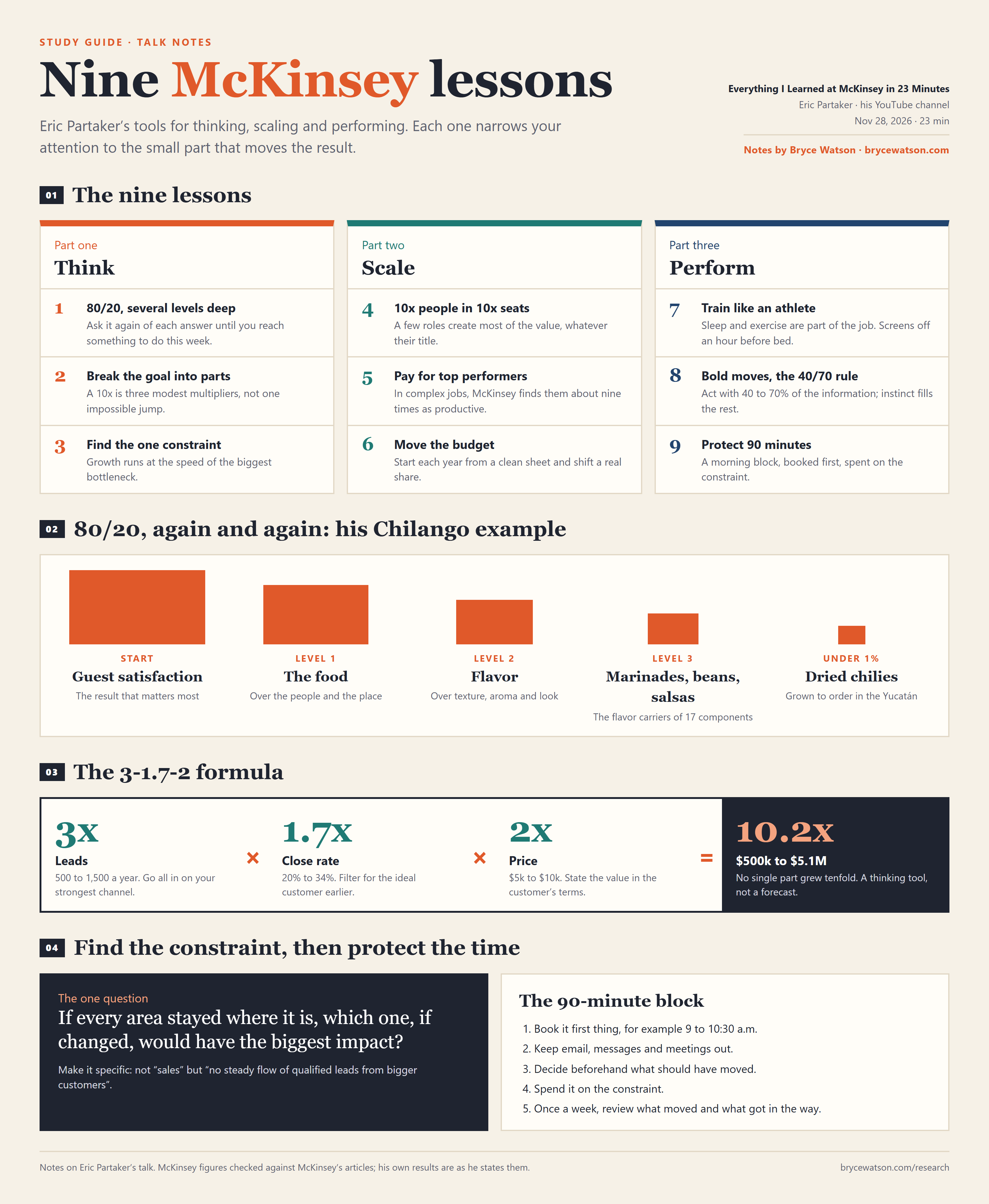
- Don't apply 80/20 once. Apply it to the answer, then again, until you reach something specific enough to act on this week.
- A 10x goal gets easier when you split it into parts: triple the leads, raise the close rate 1.7 times and double the price, and the product is about 10x.
- A business grows only as fast as its biggest bottleneck, so find the one area that would change the most before working harder on everything.
- A few roles create most of the value, so put exceptional people in those seats and pay what it takes to keep them.
- Move a real share of the budget every year, starting from a clean sheet, so money follows what matters most now.
- Protect your own performance: sleep, exercise, decide with 40 to 70% of the information, and guard a daily 90-minute block for the main constraint.
Eric Partaker, a former McKinsey consultant who later co-founded the Chilango restaurant chain, walks through nine thinking tools he says he learned there: apply 80/20 again and again until you reach something you can act on this week, break a 10x goal into smaller multipliers, find the one constraint, and put your best people and money where they count most. These are my notes on his 23-minute talk, with the McKinsey figures he cites checked against McKinsey’s own articles.
He groups the nine into three parts: how to think (lessons one to three), how to scale (four to six) and how to perform yourself (seven to nine). He introduces himself through his record, which is as he tells it: he says he advised large companies at McKinsey, helped grow Skype before eBay bought it for $2.6 billion, and has since coached more than a thousand founders and CEOs.
80/20, several levels deep
Most people know the 80/20 principle, he says, but few use it, and fewer use it the way he was taught: apply it to the 20% you found, then again to that answer. Each pass narrows the field, from the 20% that matters to 4% to under 1%.
His example is Chilango, the Mexican restaurant chain he started in London after Skype. He asked what drives most guest satisfaction and landed on the food, over the people and the place. Within food, he chose flavor over texture, aroma and look. Across 17 meal components, the flavor carriers were the meat marinades, the beans and the salsas. Within those recipes, most of the flavor came from Mexican dried chilies, which he couldn’t buy in England at the quality or price he wanted. So, as he tells it, the team went to the Yucatán Peninsula, had local farmers grow chilies for them and shipped them over in containers. He says the chain grew to 13 locations, was ranked the top Mexican restaurant by Zagat, and became a favorite on Deliveroo.
To use it, pick the result you care about most (profit, sales, customer happiness), ask which 20% of factors drive 80% of it, then ask the same question of the answer. Stop when the answer is specific enough to work on this week. Done on customers, it usually turns up a small group bringing in most of the profit. Done on problems, a handful of recurring issues causing most of the drag. The hard part, he says, is that saying yes is easier than saying no, and every project and customer has someone defending it.
The 3-1.7-2 formula
The second tool is breaking a goal that feels impossible into parts you can solve one at a time. At the simplest level, sales are leads times close rate times price, leaving aside retention and expansion.
His worked example: a business with 500 leads a year, a 20% close rate and a $5,000 average sale does $500,000 a year. Triple the leads to 1,500, raise the close rate 1.7 times to 34% (he calls that moving from a poor rate to best practice) and double the price to $10,000. That’s $5.1 million, a 10.2x increase, and no single part had to grow tenfold. He presents it as a thinking tool, not a forecast: a subscription business might find its biggest lever is keeping customers longer.
For each lever he suggests a starting move:
| Lever | Target | His suggested move |
|---|---|---|
| Leads | 3x | Find the channel where your customers are most concentrated, go all in on it, and test what works |
| Close rate | 1.7x | Narrow the ideal customer and filter for them earlier, hire better salespeople, or build a better sales system |
| Price | 2x | State the value in the customer’s terms (revenue earned, hours saved, productivity gained) so the price looks small next to it |
He adds that undercharging is one of the most common mistakes he sees, so price is often the biggest lever.
The one constraint
Breaking a goal down shows what you could work on, but not what to work on first. He draws on the theory of constraints: a chain is only as strong as its weakest link, and a business grows only as fast as its biggest bottleneck allows. Improve five other areas and growth can still stall.
His question for finding it: if every area of the business stayed at its current level, which one area, if changed, would have the biggest impact? He tells of a tech client stuck cutting costs and tightening efficiency, whose answer turned out to be a predictable way to generate revenue, meaning a strong sales team tracking the right leading indicators. He says that over five years the company’s value grew more than tenfold, past $100 million.
Make the answer specific. “Sales” is too broad; “we don’t have a steady flow of qualified leads from bigger customers” is something you can work on. It may not be a process at all. It could be a key hire, pricing, a partner, or a decision you’ve been putting off. He asks you to write it down, because the last lesson comes back to it.
10x seats and what to pay
Once you know the constraint, you need the right people to fix it. McKinsey’s shorthand, which he quotes, is that 5% of roles create 95% of a company’s value. McKinsey’s more recent talent work puts it as 30 to 50 critical roles driving about 80% of value, which makes the same point.
He calls these 10x seats and the people in them 10x people. Trying to fill every seat with top performers doesn’t work, he says: most roles don’t need it, and there aren’t enough of those people anyway. A 10x seat is defined by its effect on the business, not its title. His example is UPS, which plans routes to avoid left turns at busy intersections, because waiting across oncoming traffic wastes time and fuel and raises the risk of accidents. Across a large fleet he says that saves millions a year, which makes the routing engineer behind it a 10x seat. Which seats count depends on the business:
| Business | Likely 10x seats, as he gives them |
|---|---|
| AI or software company | The engineers building the core product, and whoever wins the biggest customers |
| Manufacturing | Whoever runs the factory floor, and whoever looks after the biggest accounts |
| Professional services | The people who win and keep the big clients, and those who deliver the work they pay most for |
A 10x person isn’t someone who works ten times harder. It’s someone who owns outcomes without waiting to be told, makes good decisions on their own and raises the standard of the people around them.
Those people cost more, and his fifth lesson is that it’s worth it. McKinsey’s talent research found that in highly complex jobs, such as managers and software developers, high performers are 800% more productive than average ones, so about nine times as productive. That figure comes from McKinsey’s War for Talent survey, first run in 2000 and refreshed in 2012. His arithmetic: if the average person in a 10x seat costs $100,000 and a high performer asks $150,000, you’re paying 50% more for up to nine times the output. Keeping them takes more than pay, he says: take admin off their plate, give them room to grow and allow some flexibility.
Moving the budget
If you can’t afford those salaries, he says the money is probably already in your budget. McKinsey found that about a third of companies move only around 1% of their capital between units each year, against an average of 8%. The question he says the best CEOs ask is what it would look like to move 10% of the budget to what matters most.
On a $2 million annual expense budget, 1% frees $20,000; 10% frees $200,000, enough to pay two senior hires $200,000 each instead of $100,000 without raising the total. The habit behind it is starting each year from a clean sheet, where every dollar has to justify itself, cutting what isn’t working and moving the money to what is.
He says companies that move more than half their capital over ten years create 50% more value. The McKinsey study behind the 50% figure is a separate one, and its cutoff is more than 60% of capital spending shifted over ten years. McKinsey’s 2016 article on reallocation puts the gap another way: an active reallocator returns about 10% a year to shareholders against 6% for a slow one, enough to be worth twice as much within 20 years.
Energy, bold moves and the 40/70 rule
The last three lessons are about the CEO. The seventh is to treat yourself like an elite athlete, who manages performance off the field as well as on it. He cites CEO Excellence, McKinsey’s book on about 200 top-performing CEOs, for the point that the best manage their energy. His two levers are sleep and exercise, and his first step is getting off screens an hour before bed, to cut the late stimulation and the blue light that he says delays sleep.
The eighth is making big, bold moves. He describes it as reaching the top fifth of your sector. McKinsey’s research ranks the world’s largest companies by economic profit, and finds that one in the middle three fifths has about an 8% chance of reaching the top fifth within ten years. He says that with three or more bold moves the odds rise to about 50%. Bold moves include a new strategy, a new market, an acquisition, a new leadership team, a new product line, or reallocating money as in the sixth lesson. Since you never have all the information for a move like that, he uses Colin Powell’s 40/70 rule: once you have 40 to 70% of the information you think is available, decide and let instinct fill the gap. Wait for certainty and it’s usually too late.
The ninth is protecting time. Citing the Economist Intelligence Unit, he says the average person loses about a quarter of working time to distractions, which he likens to playing only three quarters of a basketball game, or about a decade across a 40-year career. His fix is a 90-minute block at the start of the day, for example 9 to 10:30 a.m., booked before anything else can take it, with email, messages and meetings kept out. Use it on the constraint from the third lesson, decide beforehand what should have moved by the end, and once a week review what moved, what got in the way and what to change.
How to try it
The nine lessons fold into one sequence you can start this week:
- Pick the result you care about most and run 80/20 on it until the answer is a specific thing to do.
- If the goal is a big multiple, write it as a product of its parts and set a modest multiplier for each.
- Ask which single area, if changed, would have the biggest impact, and write the answer down in one specific sentence.
- List the few roles that move that result most, and check whether each has someone who owns the outcome.
- Before next year’s budget, ask what moving 10% of it to the constraint would look like.
- Book a 90-minute block tomorrow morning for the constraint, and review it at the end of the week.
Key terms
- 80/20 principle
- The pattern that roughly 20% of causes drive 80% of results; he applies it repeatedly to get from 20% to 4% to under 1%.
- 3-1.7-2 formula
- His split of a 10x sales goal: three times the leads, 1.7 times the close rate, two times the price.
- Theory of constraints
- The idea that a system's output is set by its weakest link, so improving anything else changes little.
- 10x seat
- A role whose performance has an outsized effect on the business, whatever its title or seniority.
- 10x person
- Someone who owns outcomes without being told, decides well alone and raises the people around them.
- 40/70 rule
- Colin Powell's rule: act once you have 40 to 70% of the available information, and let instinct fill in the rest.
Quotes from the talk
When everything is important, nothing gets enough force for you to break through.
You don't need extraordinary people everywhere in your business.
Wait until you're completely sure, and it's usually too late.
Study guide
The same notes as one tall page, made to print or keep. The preview shows the top; open it for the whole thing.