Key ideas
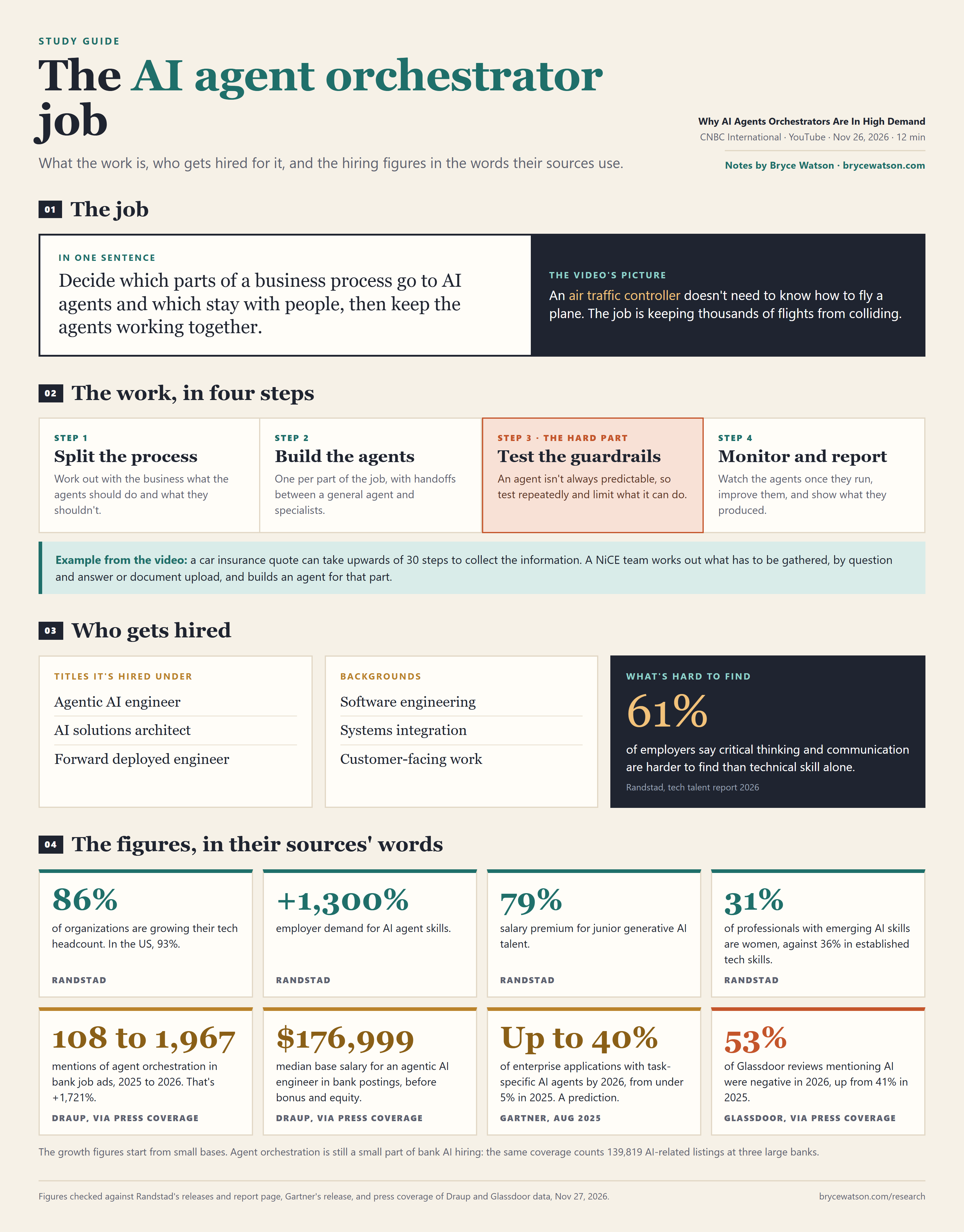
- The job is deciding which parts of a business process go to AI agents and which stay with people, then keeping the agents working together.
- Most of the effort goes into testing and guardrails, because an agent doesn't behave the same way every time.
- It's hired under several titles, mainly agentic AI engineer, AI solutions architect and forward deployed engineer.
- Technical skill gets a candidate considered, but employers say judgment and communication are harder to find.
- The growth figures are real but start from small bases: agent orchestration went from 108 to 1,967 mentions in bank job ads.
- The video expects running agents to become part of most jobs, not only a job of its own.
An AI agent orchestrator decides which parts of a business process go to AI agents and which stay with people, then builds, tests and monitors the agents so the whole process gets done. CNBC’s 12-minute video says it’s part job and part skill, and that it shows up under titles like agentic AI engineer, AI solutions architect and forward deployed engineer. The people hiring for it say the hard part to find is judgment and communication, not the tooling. These are my notes on the work, who gets hired and the hiring numbers, with each figure checked against the report it came from.
What the job is
The video defines orchestration as dividing work between people and AI agents so that a whole business process gets done. One interviewee calls it a traditional skill: understand the business, then decide what the machine should do and what it shouldn’t.
It gives a short history of how the job appeared. Language models arrived first, and people used them by typing text. Writing that text well became prompt engineering. Then software was put around the model to run the exchange without a person, and that software is an agent. You can make as many agents as you like, so the work becomes controlling and limiting what they do.
Day to day, the video lists the work as:
- designing and managing the agents themselves
- making several agents work together as one system
- maintaining, reviewing and improving them
- reporting what the agents produced, so the business can see their value
One interviewee compares the role to an air traffic controller, who doesn’t need to know how to fly a plane but has to keep thousands of flights from colliding.
Two worked examples
An insurance quote. NiCE, which makes customer service software, has a forward deployed engineering team that works inside its customers’ businesses. Its lead says a car insurance quote can take upwards of 30 steps to collect enough information. The team runs a workshop on what has to be gathered and how, by question and answer or by uploading a document, then builds an agent to do that part.
A handoff. In a second NiCE example, an energy company has one general assistant agent. When a case needs a specialist, the assistant recognizes it, captures the details and hands over to a second agent. That agent works the case to its outcome and hands back.
The lead says the hardest part of both is testing and control. An agent isn’t always predictable, so the team tests repeatedly and checks that each one has the right guardrails, then keeps monitoring it once it’s running.
Who gets hired
Titles. The video says the term turns up in postings for agentic AI engineers, AI solutions architects and forward deployed engineers.
Backgrounds. It names software engineering, systems integration and customer-facing work. The NiCE lead spent 15 years in pre-sales consulting, and says what he brought was the habit of designing and thinking through systems.
What to learn. The Model Context Protocol, agent-to-agent protocols and the frameworks for building agents. One interviewee says the AI companies publish enough for people to teach themselves.
What’s hard to find. In Randstad’s survey, 61% of employers say talent with critical thinking and communication is harder to find than technical skill alone. One interviewee says he doesn’t hire from the CV. He looks for process thinking, commercial judgment, an understanding of systems and operations, and some background in automation.
How companies fill the gap. A Randstad interviewee gives three routes: buy the skill by hiring, build it by training, or borrow it through flexible work.
Hiring figures
These are the figures behind the video, in the wording their sources use. Randstad surveyed 1,100 senior decision-makers in 11 markets in August 2026 and analyzed more than 20 million job postings.
| Figure | What it measures | Source |
|---|---|---|
| 86% | Organizations growing their tech headcount; 93% in the US | Randstad, US release |
| 61% | Employers who say critical thinking and communication are harder to find than technical skill | Randstad |
| +1,300% | Employer demand for AI agent skills; the page doesn’t give the period | Randstad |
| More than 5x | Growth in job postings that require AI capabilities, over the past year | Randstad |
| 79% | Salary premium for junior generative AI talent | Randstad |
| 17% and 13% | Median premium for software engineers in healthcare and life sciences, and in banking | Randstad |
| 31% | Women’s share of professionals with emerging AI skills, against 36% of those with established tech skills | Randstad |
| +1,721% | Mentions of agent orchestration in bank job ads: 108 in 2025, 1,967 in 2026 | Draup’s data, as reported by TechStartups |
| $176,999 | Median base salary for an agentic AI engineer in bank postings, September 2026, before bonus and equity | Draup’s data, as reported by TechStartups |
| Up to 40% | Enterprise applications with task-specific AI agents by 2026, up from under 5% in 2025; a prediction made in August 2025 | Gartner |
| 53% | Glassdoor reviews mentioning AI that were negative in 2026, up from 41% in 2025; 81% were positive in 2019 and 43% in 2026 | Glassdoor’s data, as reported by The Decoder and Futurism |
Two things help when reading them. The 1,721% counts mentions of a skill, and the same coverage puts AI-related listings at JPMorgan Chase, Citigroup and Capital One at 139,819 for the year, so agent orchestration is still a small part of bank AI hiring. And the video gives a few figures I couldn’t find in these sources, including a fifteenfold rise in orchestration postings over four years and a US salary range of $115,000 to $239,000, so they aren’t in the table.
What it means for other jobs
The video’s closing argument is that orchestration won’t stay one job. As more people are expected to manage several agents, one interviewee calls it part of everybody’s job in an organization.
On whether agents replace people, the interviewees say they add management work. One says a team with agents can produce two or three times its usual output without new hires, and that each agent may need people to manage it, so one orchestrator becomes a team. Another says that talking about replacement makes staff reluctant to try the tools at all. The people saying this build agents or recruit for the work, and the Glassdoor figures show employees are less convinced.
How to use it
- Quoting a figure: use the source’s wording from the table. “Employer demand for AI agent skills” and “mentions in bank job ads” are narrower than “job postings”.
- Reading a job ad: look for the work, not the title. Splitting a process between people and agents, testing guardrails and monitoring handoffs is the job under any of the three titles.
- Preparing for the role: the video’s own list is a systems background, time with customers, the agent protocols and frameworks, and evidence of judgment and communication.
Key terms
- AI agent
- Software wrapped around a language model that takes a goal, uses tools and carries out steps without a person typing each prompt.
- AI orchestration
- Dividing a business process between people and AI agents, and coordinating the agents so the whole process gets done.
- Forward deployed engineer
- An engineer who works inside a customer's business, finds the work agents can do, and builds the systems to do it.
- Handoff
- One agent passing a task, with the details it has gathered, to a more specialized agent and getting it back when that part is done.
- Guardrails
- The limits and checks placed on an agent so it stays inside what the business allows.
- Model Context Protocol (MCP)
- An open standard for connecting AI agents to tools and data.
- Buy, build, borrow
- Three ways a company gets a scarce skill: hire it, train its own staff, or bring in contractors.
Study guide
The same notes as one tall page, made to print or keep. The preview shows the top; open it for the whole thing.