Key ideas
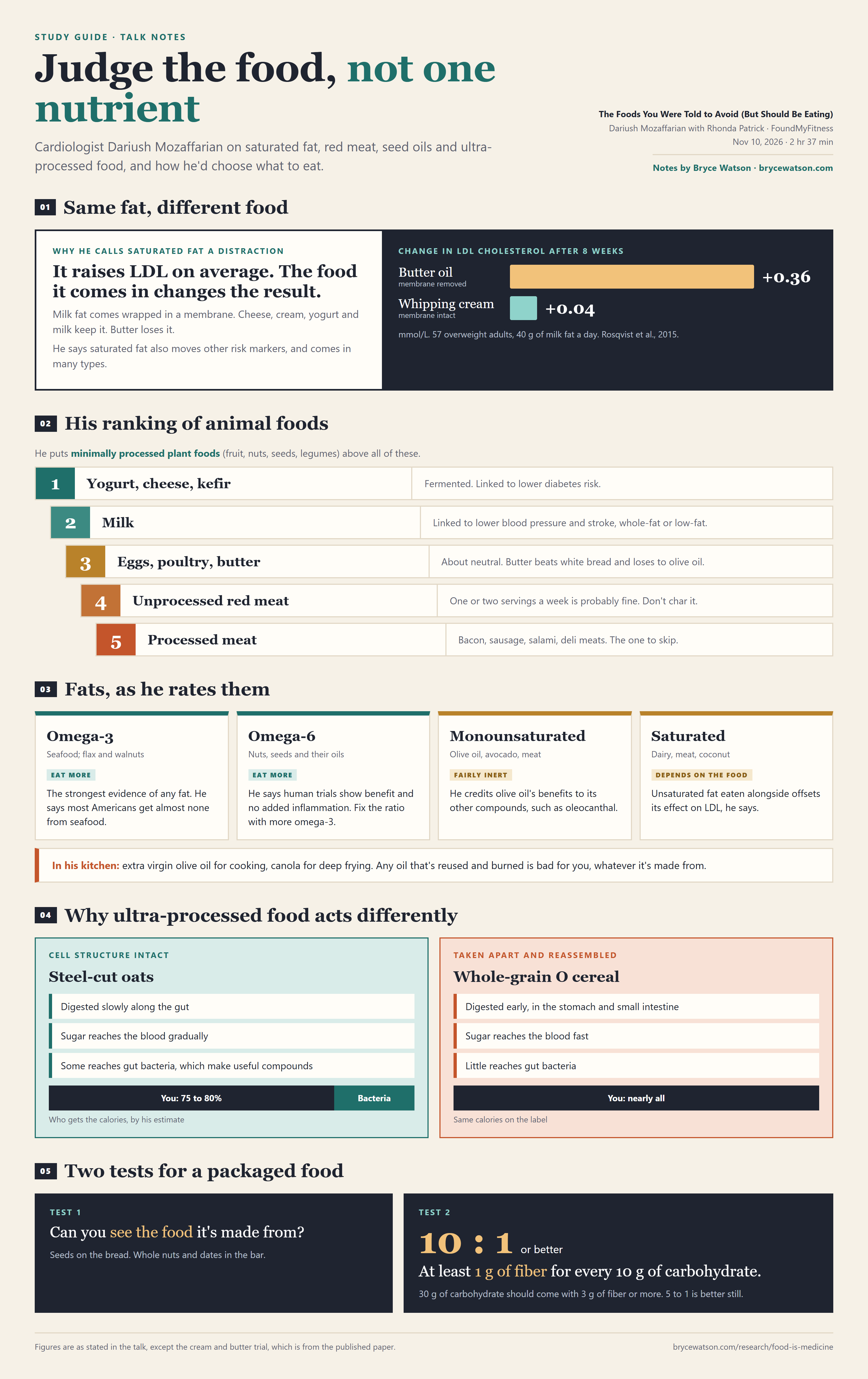
- Judge a food by the whole food and how processed it is. Saturated fat raises LDL cholesterol on average, but it also moves other risk markers, comes in many types and acts differently in different foods, so he calls it a distraction.
- Among animal foods he puts yogurt and cheese first, then milk, then eggs, poultry and butter, then unprocessed red meat at one or two servings a week, with processed meat last.
- Fats from plants and seafood are the ones to eat more of. He says omega-6 fats and seed oils are good for people, and that the fix for a poor ratio is more omega-3, not less omega-6.
- Ultra-processed food has lost its cell structure, so it's digested early: sugar reaches the blood faster, less food reaches gut bacteria and you absorb more of the calories yourself.
- Two tests for a packaged food: can you see the food it's made from, and does it have at least 1 gram of fiber for every 10 grams of carbohydrate.
- He argues that obesity kept rising after 2000, when calorie intake went flat, because people burn less energy at rest, and that food quality drives that. This part is his hypothesis, built on newer studies.
Dariush Mozaffarian, a cardiologist who runs the Food is Medicine Institute at Tufts, says to judge a food by the whole food and how processed it is, not by one nutrient like saturated fat. These are my notes on his two and a half hours with Rhonda Patrick: where he ranks dairy, eggs, red meat and processed meat, why he calls seed oils and omega-6 fats good for you, his fiber rule for packaged food, and his account of why obesity kept rising after calorie intake went flat.
Saturated fat and dairy
He’s clear that LDL cholesterol is a real risk factor for heart disease, and that saturated fat raises it on average. His argument is that this one effect doesn’t settle whether a food is good for you, for three reasons:
- It does other things too. Changing saturated fat also changes triglycerides, HDL and other markers, and those effects partly offset the LDL one.
- There are many saturated fats. They run from 2 to 24 carbons long. Palmitic acid, at 16, is the common one. He says the shorter MCTs raise LDL but improve other markers enough that small trials found a net benefit.
- The rest of the food matters. Milk fat comes wrapped in a membrane that, as he tells it, binds cholesterol in the gut and lowers how much is absorbed. Cheese, cream and yogurt keep it. Butter loses it.
The trial he leans on is from Ulf Risérus’s group in Sweden. For 8 weeks, 57 overweight adults ate 40 g of milk fat a day, as whipping cream or as butter oil. LDL rose by 0.36 mmol/L on the butter oil and by 0.04 on the cream, with no difference in HDL (Rosqvist et al., 2015). The fat was the same and the food was different.
Butter is still the dairy food he rates lowest, and he calls it neutral. It’s a worse choice than olive oil or another plant oil, and a better one than white bread or sugar. On whole-fat against low-fat dairy he says the studies show no real difference for heart disease, diabetes or weight, and that the kind of dairy matters more: yogurt and cheese for diabetes risk, milk for blood pressure and stroke.
How nutrition got focused on single nutrients
His history has three parts, and it explains why the low-fat advice happened.
| Period | What happened, as he tells it | What it left behind |
|---|---|---|
| 1930s and 1940s | Vitamins were isolated, the first being vitamin C in 1932, and deficiency diseases such as pellagra and rickets turned out to have single-nutrient cures. A 1941 US nutrition conference led to enriched flour and the recommended daily allowances. | The habit of treating food as a list of nutrients to add or remove |
| 1950s to 1970s | Fear of famine led to the Green Revolution. Norman Borlaug bred high-yield wheat, then rice and corn followed, with synthetic fertilizer, pesticides and irrigation. | About half the world’s calories from rice, wheat and corn, from a few varieties bred for yield, not nutrition |
| 1980 on | Heart disease was the next target, and scientists looked for its single nutrient. They picked fat and saturated fat. | Low-fat guidelines, and products rebuilt with starch, sugar and additives |
His point is that one nutrient does cause or cure a deficiency disease, and that this isn’t true of heart disease, diabetes or obesity. He compares the known nutrients to the visible matter in physics: perhaps 5% of what’s in food, by his estimate, with millions of other compounds only now being catalogued.
Red meat and processed meat
He ranks animal foods in tiers, below minimally processed plant foods such as fruit, nuts and legumes.
| Tier | Foods | What he says |
|---|---|---|
| 1 | Yogurt, then cheese, kefir | Fermented, with compounds the bacteria make, such as vitamin K2 |
| 2 | Milk | Linked to lower blood pressure and stroke, at any fat level |
| 3 | Eggs, poultry, butter | About neutral |
| 4 | Unprocessed red meat: fresh or frozen beef, pork or lamb | One or two servings a week is probably fine; a serving a day is too much |
| 5 | Processed meat: bacon, sausage, salami and deli meats, including low-fat turkey | Strongly linked to stroke, diabetes and cancer; he blames the preservatives and processing |
With red meat he says the problem isn’t the fat, so a lean cut and a fatty cut are about the same. He points to heme iron, which he calls inflammatory in excess and damaging to the cells that make insulin, and to compounds that gut bacteria turn into carcinogens. That fits the pattern he describes: red meat is tied more to type 2 diabetes and to cancer of the far end of the colon than to heart disease.
Two things change the picture. Charring meat forms more carcinogens, so he’d avoid blackened meat. And the rest of the diet matters: he cites one trial, funded by the meat industry, where a Mediterranean-style diet blunted the TMAO that red meat produced. Asked whether four servings a week is fine on a very good diet, he says there’s no study that answers it, and that he’d expect the change in risk to be trivial.
Seed oils, omega-3 and omega-6
His summary of fats is that the ones from plants and seafood are the ones to eat more of. He suggests about 45% of calories from fat, mostly from those sources.
| Fat | Where it comes from | His view |
|---|---|---|
| Omega-3 | Seafood; a shorter form in flax and walnuts | The strongest evidence of any fat, and most Americans eat almost none from seafood |
| Omega-6 | Nuts, seeds, soybean and canola oil | Beneficial in human trials for blood sugar and blood fats, and not inflammatory. The idea that it competes with omega-3 comes from rodent studies |
| Monounsaturated | Olive oil, avocado, also meat | Fairly inert as a fat. He credits olive oil’s benefits to its other compounds, such as oleocanthal |
| Saturated | Dairy, meat, coconut | Depends on the food, and unsaturated fat eaten with it offsets its LDL effect |
He co-wrote the 2009 estimate that put too little seafood omega-3 behind 84,000 US deaths in 2005, next to 82,000 from trans fat (Danaei et al., 2009).
He traces the worry about seed oils to three things: the real harm of industrial trans fats, the solvent traces left from extracting oil from seeds, and the omega-6 to omega-3 ratio. His answers are that the trials showing benefit used these same oils, and that the ratio is best fixed by eating more omega-3. He agrees with one concern: any oil that’s reused and burned, as in a fast-food fryer, is bad for you, whatever it’s made from.
At home he cooks with extra virgin olive oil for the taste and uses canola for deep frying, because he says it’s more stable under heat. His advice is that if you’re choosing between plant oils you’re already doing well, so pick the one you like. He’s less keen on high-oleic sunflower and safflower oil, which have had the omega-6 bred out so that they last longer in a fryer.
Ultra-processed food
He uses the NOVA definition: ultra-processed food is made with additives and techniques you wouldn’t use in a home kitchen, above all cosmetic additives for color, flavor and texture. Processed food such as bread from a bakery, yogurt or canned tuna is a different group, and he’s fine with it. He puts ultra-processed food at about 60% of calories in the US food supply.
He gives two causes for its rise. Low-fat guidelines made companies rebuild foods without fat, using starch, sugar and additives. And for about 20 years the two largest tobacco companies owned many of the big food brands and, he says, applied the same flavor science and marketing. He adds a US rule: under GRAS, a company can add an ingredient on its own safety review. By his figures, 99% of additives entered that way, unreviewed by the FDA.
Why it harms, in his order:
- Lost cell structure. Food that’s been taken apart and reassembled is digested in the stomach and small intestine. Sugar reaches the blood fast, less reaches the bacteria in the large intestine, and you absorb more of the calories. He says the body might absorb nearly all the calories in such a food and 75 to 80% of those in a minimally processed one.
- Lost compounds. The polyphenols and fermentable fibers mostly don’t survive.
- The additives. He used to doubt they mattered at trace amounts. He now says that as a class they aren’t inert.
- Design and contaminants. Food built to be overeaten, and plastics from pipes and packaging.
His example is Cheerios against steel-cut oats: both whole grain, and the cereal is digested far faster. He tells parents not to worry about it, since it’s not a bad cereal. The two tests he gives for any packaged food are in “What to eat” below. The fiber one comes from a study he co-wrote of 545 grain products, where a ratio of 10 to 1 or better picked out healthier products more reliably than a whole-grain stamp did (Mozaffarian et al., 2013).
Obesity and resting energy
This is the newest part of the talk, and he presents much of it as an explanation he finds likely, not a settled one.
- 1980 to 2000. Calories rose, and he says the largest single change was refined starch, up about 300 calories a person a day. Sugary drinks had been rising since the 1950s without a rise in obesity.
- After 2000. Calorie intake went flat and physical activity rose, and obesity kept climbing. What fell, he says, is the energy people burn at rest, by about 220 calories a day. The study behind this pooled measurements from 4,799 adults in the US and Europe and found total energy use, adjusted for body size and age, falling since the late 1980s while activity rose. The fall in resting energy was clear in men and not statistically significant in women (Speakman et al., 2023).
- His explanation. Less heat production, in brown fat and in muscle, which he links to diet: compounds made by gut bacteria, polyphenols and omega-3 all switch it on in experiments. He adds the calories that ultra-processed food shifts from gut bacteria to the body.
The human evidence he cites is David Ludwig’s work. In the larger trial, 164 adults who had lost 12% of their weight ate one of three diets for 20 weeks. Those on the low-carbohydrate diet burned 209 calories a day more than those on the high-carbohydrate one (Ebbeling et al., 2018). From that he argues against counting calories and for food quality, with a slow target of a pound or two a month.
On GLP-1 drugs he says he prescribes them and that they’re approved as an addition to diet and lifestyle. By his figures most people stop within a year, and without a change in eating they regain the weight as fat, having lost muscle and bone. On exercise he says trials show little weight loss from it alone, with less visceral fat, more muscle and better metabolic health.
What to eat
His advice, gathered from across the talk:
- Eat more plant and seafood fats. Nuts, seeds, olive oil, avocado and fish. Don’t ration olive oil or nuts for their calories.
- Pick dairy by kind, and fat level by taste. Yogurt and cheese first, plain where you can. Whole-fat is fine. If you eat very little other fat, low-fat dairy makes more sense, so that saturated fat isn’t most of your fat.
- Keep unprocessed red meat to a serving or two a week, don’t char it, and eat it with vegetables and herbs. Skip processed meat.
- Treat butter as neutral. Cook with a plant oil when you can.
- Check packaged food two ways. Can you see the food in it, such as seeds on the bread or whole nuts in the bar? And does it have at least 1 g of fiber for every 10 g of carbohydrate? A ratio of 5 to 1 is better still. He looks at this instead of sugar alone, since a low-sugar product can still be mostly refined starch.
- Unsweetened plant milks are fine. He uses oat milk in smoothies and dairy milk in coffee, by taste.
- If you carry APOE4, he says no study has shown a reliable diet interaction, and his advice is to eat plenty of unsaturated fat alongside any saturated fat.
He describes the newest US dietary guidelines as a large change: they say to eat real food and avoid processed food, to embrace healthy fats, and that whole-fat dairy without added sugar is fine. His worry is the protein message, which he says food companies are using to put protein in sugary drinks, pastries and candy.
Key terms
- Milk fat globule membrane
- The thin layer of specialized fats that wraps each droplet of fat in milk so it mixes with water. Cheese, cream, yogurt and milk keep it. Butter making removes it into the buttermilk.
- Palmitic acid
- The 16-carbon saturated fat, the most common one in food and in the body. It's what people usually mean by saturated fat.
- MCTs
- Medium-chain triglycerides, saturated fats 8 to 12 carbons long, found in coconut oil and dairy.
- Heme iron
- The form of iron that makes red meat red. People need some, and he says too much is inflammatory and harms the cells that make insulin.
- Omega-3 and omega-6
- The two families of polyunsaturated fat the body can't make. Omega-3 comes mainly from seafood, with a shorter form in flax and walnuts. Omega-6 comes from nuts, seeds and their oils.
- Oleocanthal
- A compound in extra virgin olive oil that acts on the same target as aspirin. He says it's the source of the burn at the back of the throat.
- NOVA
- The four-group system for classing food by processing, proposed by the Brazilian researcher Carlos Monteiro. Group 4 is ultra-processed. Nova is Portuguese for new.
- GRAS
- Generally recognized as safe. A US route, dating from 1958, that lets a company add an ingredient to food on its own safety review, without the FDA's review.
- Resting energy expenditure
- The energy the body burns doing nothing. He puts it at about 80% of a sedentary person's total and 50 to 60% for someone who exercises.
- Thermogenesis
- Burning energy to give off heat. Brown fat does it, and so can muscle.
- Brown fat
- Fat tissue that burns energy as heat instead of storing it. Adults keep some, and he says it's less active in people with obesity.
Quotes from the talk
Saturated fat has biologic activity, but it's a distraction.
Nuance is the name of the game when it comes to nutrition.
If I had to pick one superfood, it would be nuts and seeds.
Study guide
The same notes as one tall page, made to print or keep. The preview shows the top; open it for the whole thing.