Key ideas
- In crowded markets everyone hunts gaps with the same tools, so a gap you can see is one your competitors can see too.
- Every category has two markets: the organic one of people already shopping it, and a dormant one of people who could be made to want it.
- The dormant market buys choice first and need second: they see it, want it, then find a reason, so nobody is competing for them.
- Start from the value the whole category delivers, not your brand's features, and look for people who want that value but don't shop the category.
- Build the value into the product so it's obvious on contact, and reach the new audience through a channel your category never uses.
- Working on the dormant market makes you more distinctive to the people already shopping, so even a partial result pays.
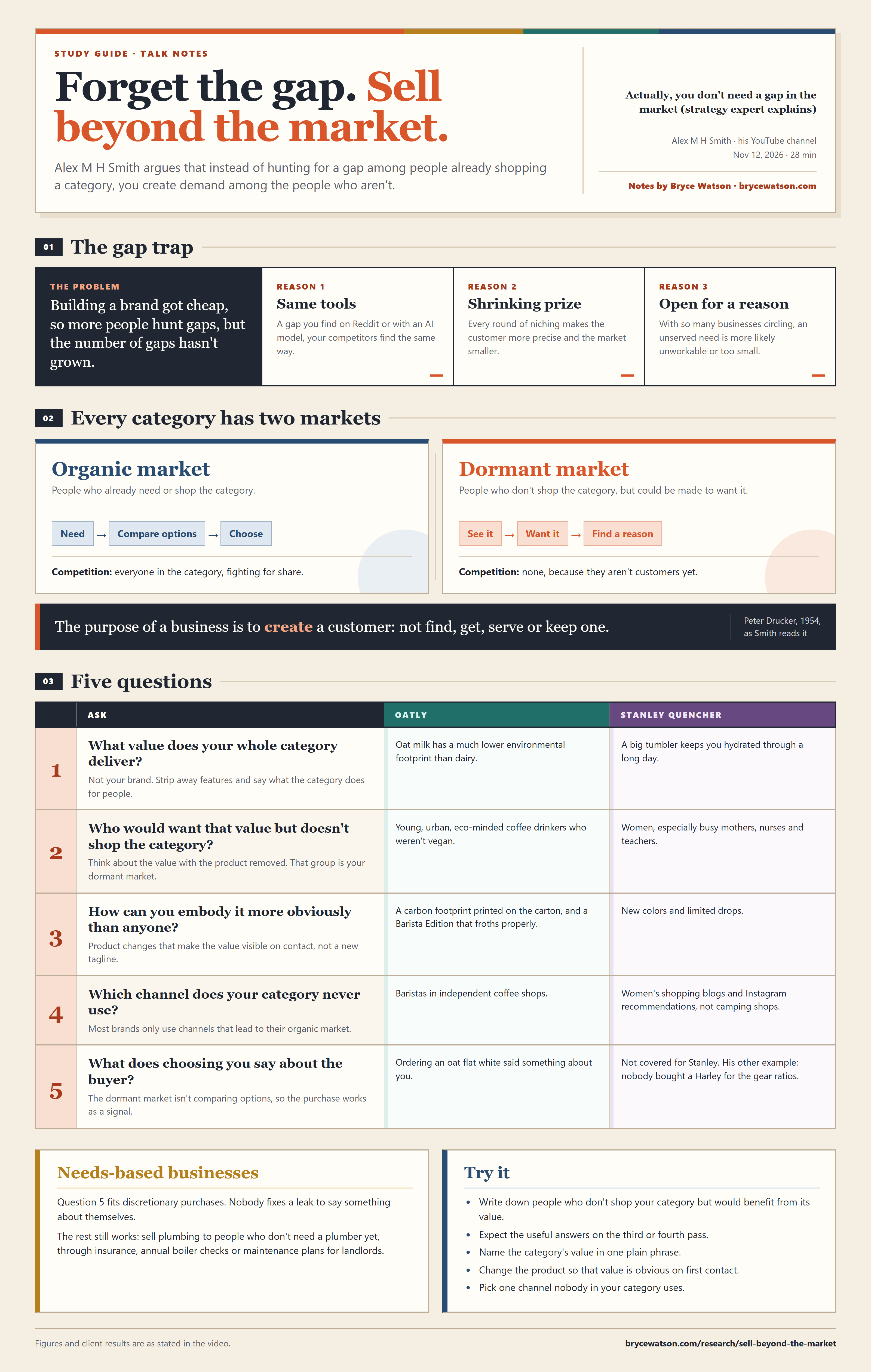
Alex M H Smith argues that most businesses don’t need a gap in the market, and that in crowded markets the gaps still open are rarely worth having. Instead of fighting over the people already shopping a category, he says, sell to the people who aren’t: work out the value the whole category delivers, find who would want that value, and reach them through a channel your competitors ignore. These are my notes on his 28-minute video, with the five questions he uses with clients.
He’s a brand strategist, and he says he’s used this approach with clients who grew twentyfold and one that sold for nine figures. Figures and client results on this page are as he gives them in the video. The video expands one of the three games for finding new value from his earlier talk on value, where selling beyond the market got a single paragraph.
The gap trap
The standard advice is to find an unmet need. He lists the usual ways of doing it: niching down to an ever more precise customer, mining Reddit threads and reviews for complaints nobody fixes, mapping competitors to find an empty quadrant, and now asking an AI model to name an untapped opportunity. He doesn’t call any of these stupid. In a market with a handful of players, they find real gaps, and that’s the setting they were built for.
His point is that most markets no longer look like that. Launching a product and a brand keeps getting cheaper and faster, AI makes it cheaper still, and the number of people hunting gaps has grown while the number of gaps hasn’t. Search Amazon for a phone case or a yoga mat and you see hundreds of near-identical listings, each seller sure they found a corner. He gives three reasons gap hunting now works against you:
- Everyone has the same tools. A gap you find by reading Reddit or asking an AI model is one your competitors find the same way, so you don’t keep it long.
- The prize shrinks as you dig. Each round of niching defines the customer more precisely and makes the market smaller.
- Open gaps are usually open for a reason. With so many businesses circling, an unserved need is more likely unsolvable or too small than overlooked.
All of these techniques search for demand that already exists. The bigger opportunity, he says, is creating demand.
Two markets
He builds on Peter Drucker’s line from The Practice of Management (1954) that the purpose of a business is to create a customer. Smith reads the word “create” literally: not find, get, serve or keep, but bring into being a customer who doesn’t exist yet. The customers already shopping are taken and fought over; the ones who could be created are close to unlimited.
So he splits every category into two markets:
| Market | Who’s in it | How they buy | Competition |
|---|---|---|---|
| Organic | People who already need or shop the category | Need first, then choice: compare the options | Everyone in the category |
| Dormant | People who don’t shop it or think about it | Choice first, then need: see it, want it, find a reason | None, because they aren’t customers yet |
Choice before need
His example is the motorbike. Some people buy a Harley-Davidson because they need a bike and compared the options. Most, he says, see a Harley, think it looks great, and decide they should get a bike. The want came first. He points out how many of our own purchases work this way: a gadget, a jacket, a coffee machine we weren’t shopping for until a brand put it in front of us.
That’s the core of the video: ordinary brands sell to people who already want what they sell, and the great ones sell to people who don’t want it yet. He calls it selling beyond the market.
He adds that it doesn’t cost you the existing market. Vegans still buy Oatly, bikers still buy Harleys. The thinking it takes to appeal to outsiders pushes a brand into such a distinctive position that it also wins more of the people already shopping. So even if you never crack the dormant market, he says, you come out more differentiated than competitors still fighting over the same customers.
Oatly and Stanley
Oatly. Oat milk existed long before it took off, and so did Oatly, which grew out of Lund University research in the 1990s. For about twenty years, he says, it sold to the small group who wanted it: people who couldn’t drink dairy, and some vegans. A new chief executive, Toni Petersson (who took over in 2012), changed the question from how to sell more oat milk to oat milk drinkers to how to sell it to the people who never drink it. The answer was to lead with a benefit of the whole category, a much lower environmental footprint than dairy, and take it to young, urban, environmentally minded coffee drinkers who weren’t vegan. The channel was one no milk brand prioritized: baristas in independent coffee shops. Smith says Oatly was in about 650 coffee shops by the end of 2017 and had grown revenue to about $421 million by 2020.
Stanley. Stanley has made flasks since 1913 for construction workers and campers. Its 40-ounce Quencher tumbler came out in 2016, didn’t sell, and Stanley stopped restocking it. Three women who ran a shopping blog, The Buy Guide, made the case for selling it to a different audience: women, especially busy mothers, nurses and teachers who wanted to stay hydrated through a long day. Stanley leaned in with new colors and limited drops, the tumbler spread by recommendation, and he says revenue went from $73 million in 2019 to $750 million in 2023. He’s careful to say Stanley can’t claim the insight, only that it paid attention.
He says he’s done the same with his own clients: making a juice shot brand, MOJU, appeal beyond health enthusiasts, and helping Biotiful Gut Health take kefir from a small group of buyers to the mainstream. Müller bought Biotiful in 2025. He also names Apple, which sold computers to people who didn’t want computers.
Five questions
He keeps the examples short here and spends the time on how to apply each question:
- What underlying value does your category deliver? Not your brand, the whole category, as if it were one product. Strip away features and packaging and ask what it does for people at a level so broad nobody bothers to say it. Lower emissions for oat milk; the freedom of the open road for motorbikes.
- What sort of people would want that value? Think about the value with the product removed. You’re looking for people who’d like it but haven’t realized this category is a way to get it, such as eco-minded coffee drinkers who aren’t vegan. That’s your dormant market.
- How can your business embody that value more obviously than the competition? Not a new tagline: product changes that make the value visible. Oatly printed its carbon footprint on the carton. For MOJU, he says, the category’s value was a kick of performance from natural ingredients, so they made every shot taste fiery enough that you feel it at once. Harley built freedom into everything: bikes you can customize, a riders’ club with rallies, even an attempt to trademark the sound of its engine (it applied in 1994 and dropped it in 2000). People who aren’t thinking about your category need to see the value from a distance and feel it the moment they engage.
- Which channel can reach that audience that your category never uses? Most businesses only use the channels that lead to their organic market, which is why they never reach anyone else. Oatly went through baristas, with a Barista Edition built to froth and pour properly. Stanley went through women’s shopping blogs and Instagram recommendations, not camping shops or hiking blogs.
- What does choosing you say about the buyer? This is the step he says supercharges the rest. The dormant market isn’t comparing options, so being the best barely matters. What gets them over the line is wanting to be the kind of person seen with a product like yours. Nobody bought a Harley for the gear ratios, and ordering an oat flat white a few years ago said something about the person ordering it. The purchase becomes a signal.
Needs-based businesses
He’s clear that question five belongs to discretionary purchases, things people choose to buy. A plumber can’t sell an emergency to someone who isn’t having one, and nobody fixes a leak to say something about themselves.
The rest still applies. You can sell plumbing to people who don’t need a plumber right now: plumbing insurance, annual boiler checks, maintenance plans for landlords. Find the category’s value, find who cares about it but isn’t shopping, embody it better than anyone, reach them through a door competitors don’t use, and where you can, make choosing you mean something.
How to try it
His exercise takes a few minutes. Write down the people who aren’t shopping in your category now but would genuinely benefit from the value it creates. Expect it to be hard. He says the useful answers usually turn up on the third or fourth pass, and the struggle is a sign you’re looking somewhere new. Then run the other four questions against the best group on the list:
- Name the category’s value in one plain phrase.
- Change something in the product so that value is obvious on first contact.
- Pick one channel nobody in your category uses that reaches that group.
- If it’s a discretionary purchase, write what buying it says about the buyer.
Key terms
- Gap trap
- His name for chasing ever smaller niches and unmet needs in markets where any gap left is visible to everyone, tiny, or unworkable.
- Organic market
- People who already need or shop for what a category sells, and where all the competition is.
- Dormant market
- People who don't shop the category or think about it, but could be persuaded to want it.
- Choice before need
- How the dormant market buys: they want a specific thing first and work out why they need it afterwards.
- Category value
- The broad benefit every brand in a category delivers, such as lower emissions for oat milk or freedom for motorbikes.
- Selling beyond the market
- Creating demand among people outside a category's current shoppers instead of fighting for share among them.
Quotes from the talk
Great brands, they sell to people who don't want it yet.
The best strategy is always going to be to refuse to compete.
Study guide
The same notes as one tall page, made to print or keep. The preview shows the top; open it for the whole thing.