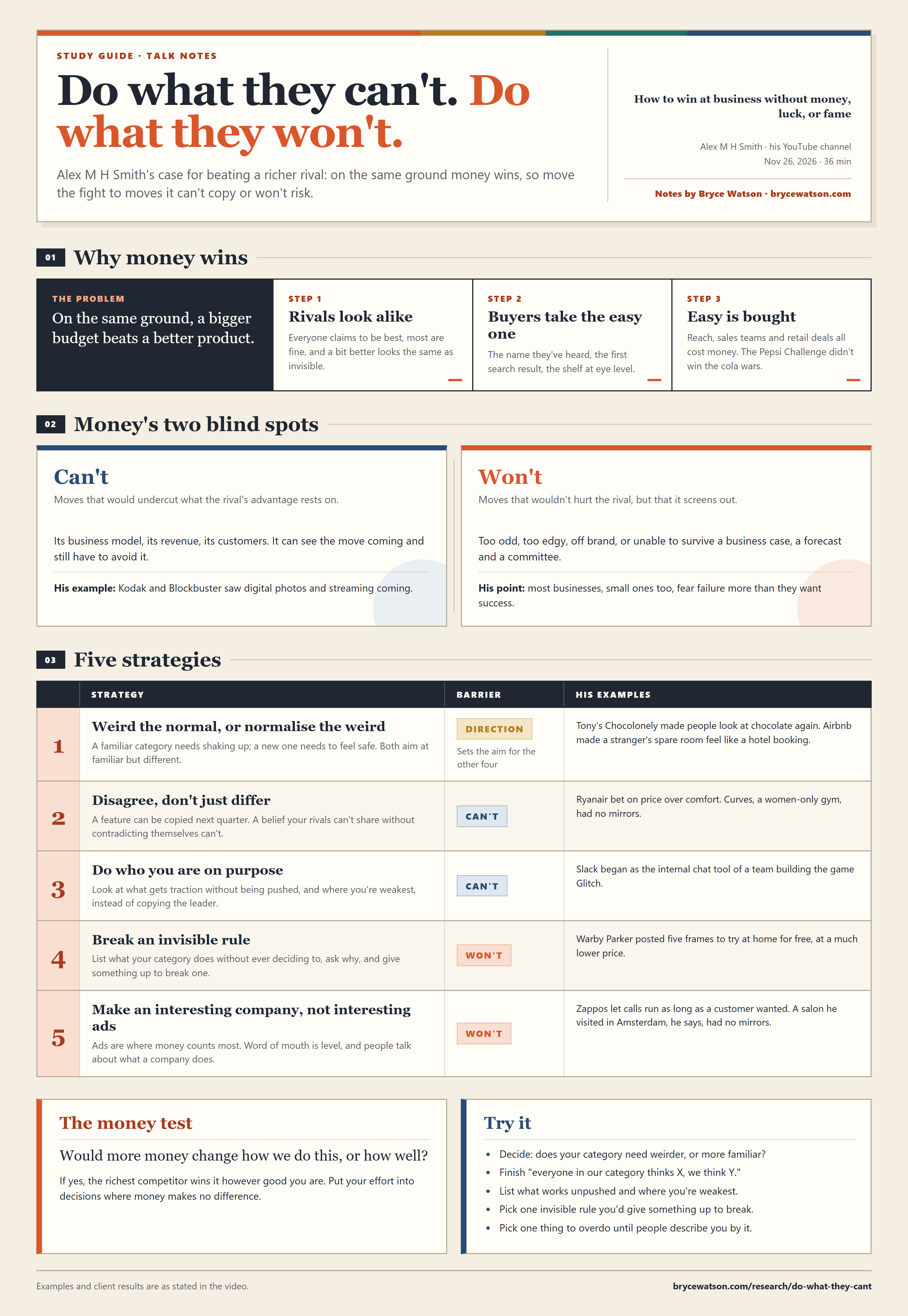
Key ideas
- When customers can't tell competitors apart, they pick the one they've heard of, so on the same ground the bigger budget beats the better product.
- A richer rival has two blind spots: moves it can't make without undercutting its own business, and moves it won't make because they're too odd or risky.
- Decide first whether your category is normal and needs weirding, or new and needs normalising; both aim at familiar but different.
- A belief your rivals can't share without contradicting themselves is harder to copy than a feature, and it's easier to find in a difference you already have.
- Every category runs on unexamined habits, and breaking one costs you something, which is exactly why others won't follow.
- Put creativity into the business itself rather than the ads, because word of mouth is the one channel where money doesn't count.
Alex M H Smith’s advice for a business up against a richer rival is to stop competing where money decides and move the fight to things the rival can’t do, because it would damage their business, or won’t do, because it’s too odd or risky to get through a big company. When customers can’t tell competitors apart, they pick whoever they’ve heard of, and that’s bought with money. These are my notes on his 36-minute video and its five strategies, with the examples he uses for each.
He’s a brand strategist, and he says he’s used this with challenger brands that grew twentyfold or sold for nine figures. Client results on this page are as he gives them. It’s a companion to his talk on selling beyond the market, which goes after customers a leader isn’t serving; this one goes after moves a leader can’t or won’t copy.
Why money wins
He starts with a question: is the biggest player in your category the best, or just the biggest? Usually the biggest. His example is the Pepsi Challenge, the blind taste tests Pepsi ran in shopping centres in the 1970s, which people often won for Pepsi. Coke still won the cola wars.
His explanation is that when several companies compete on the same things, customers from outside can’t tell them apart. Every accountant, agency and protein bar claims to be best, most are fine, and being a bit better looks the same as being invisible. So the choice falls to whoever is easiest: the name you’ve heard, the first search result, the shelf at eye level, the biggest sales team, the best retail deals. All of that is bought.
He frames money as stored effort. A huge marketing budget behind an average product is brute force, the same as a founder working all hours, at a scale you can’t match. If you fight a richer rival on the same ground by working harder or being slightly better, he says, you lose, not because you’re worse but because they can outspend and outlast you.
Can’ts and won’ts
Money has two blind spots, and the rest of the video is built on them.
| Blind spot | What it means | His example |
|---|---|---|
| Can’t | A move that would undercut what the rival’s advantage rests on: its business model, its revenue, its customers | Kodak and Blockbuster saw digital photos and streaming coming; pursuing them would have damaged businesses that were working |
| Won’t | A move that wouldn’t hurt them but is off brand, too edgy, or can’t survive a big company’s need for a business case, a forecast and a consensus | Ideas that can only be proven by doing them, which a committee won’t approve and nobody owns |
He adds that small businesses aren’t immune to the second one. Most businesses fear failure more than they want success, so they pick the safe option, which lowers the risk of failing and raises the risk of being one of forty options nobody can tell apart. David doesn’t beat Goliath by luck, he says, but by refusing to fight where size matters. The five strategies below each lean on a can’t or a won’t.
Weird or normal
The first strategy sets the direction for the rest. He says there are two games:
- Weirding the normal. In a familiar category (coffee, accountancy, shoes, insurance), shake people out of the habit where money wins. His example is Tony’s Chocolonely, the Dutch chocolate brand, whose packaging and, he says, a bar twice the usual thickness made people look again.
- Normalising the weird. In a new or strange category, make it safe and easy to buy. Airbnb’s idea, sleeping in a stranger’s spare room, was odd enough that most of what it built (profiles, reviews, professional listing photos, safer payments) existed to make it feel like booking a hotel.
Both end in the same place: familiar but different. The common mistake is going the wrong way. Normal businesses copy the category’s website, language and promises and blend in, and new ones lead with jargon and novelty and scare buyers back to what they know.
Disagreement
He ranks strategy like this: better is weak, different is good, and disagreeing is best. A difference such as a feature can be copied next quarter. A business built on believing the opposite of its rivals can’t be copied without them contradicting themselves. That’s a can’t.
The form is “everyone in our category thinks X, we think Y”:
- Ryanair. Most airlines, even low-cost ones, think flying should be pleasant. Ryanair bet that people care far more about price, and built everything on that. No full-service airline can follow it.
- Curves. Gyms assumed a gym was a place to be seen, with mirrors and serious lifters. Curves, a women-only chain, went the other way, with no mirrors. He says leaving out changing rooms let it open in sites other gyms couldn’t use, and it became one of the biggest fitness franchises in the world.
The catch, he says, is that most companies don’t actually disagree with anyone. An agency that “disagrees” by believing creativity matters is agreeing loudly.
Accidental differences
To find a real disagreement, he borrows a line he credits to Dolly Parton: find out who you are and do it on purpose. Most businesses do the reverse: they pick a polished version of the market leader and spend years sanding off whatever doesn’t fit, often removing the one thing that set them apart.
His example is Slack, which started as the internal chat tool of a company building an online game, Glitch. The game failed, the team noticed the tool was the valuable part, and Salesforce bought Slack for $27.7 billion in a deal announced in 2020. They didn’t invent the difference; they noticed it and took it seriously.
Two questions he uses with clients:
- What gets traction without being pushed? The product or team nobody champions that quietly does well is a sign of where the leverage is.
- Where are you much weaker than rivals? Ask whether it matters, and what would happen if you got weaker still. A rival that’s strong there can’t follow you into being weak on purpose.
Invisible rules
Every category has habits nobody decided on and nobody notices: cars have four wheels, law firms bill by the hour, CRM software charges per seat, ketchup comes in clear bottles. Because they’re invisible, nobody thinks to break them, and because they’re built into how rivals operate, they’re hard to follow once someone does.
His method is to list everything in your category that’s so standard nobody would comment on it, in the product, the price and how it’s sold, then ask of each one why it’s done that way and whether the reason holds. Usually the honest answer is that everyone else does it.
His example is Warby Parker. Glasses were bought in a shop, to try frames on, and cost a lot. Warby Parker posted five frames to try at home for free and sold them for much less. Anyone could have done it.
He’s frank that this is where knowing and doing split. Breaking a rule means giving something up, and most teams want the edge without losing any of the normal. That reluctance is what makes it a won’t for rivals, and getting past it yourself is the hard part.
Interesting companies
The last strategy is about execution, and it’s the idea he started his consulting practice on: make interesting companies, not interesting advertising. Advertising is where money counts most, since the biggest budget buys the most reach and the best creative people. Word of mouth is level, and people talk about what a company does, not its ads.
His test: what’s the laziest way someone would describe you? Nobody describes Patagonia without mentioning the environment, or Ryanair without mentioning that it’s cheap. Most banks, hotel chains and accountants have no such description.
The fix is to treat everything the business does as a creative canvas, and to go far past what’s sensible on one or two things:
- A hair salon in Amsterdam he says he visited, Bubble Kid, which he describes as having no mirrors, so clients trust the stylist and talk to each other.
- Little Dish, a children’s food client of his, whose packs he says came in black and white for the child to colour in.
- Zappos, which let call centre staff stay on the phone as long as a customer wanted, with no scripts. Its record calls have run past ten hours.
None of these needs a big budget; a salon with no mirrors costs less. They need a willingness to do something that doesn’t add up on a spreadsheet, which is why a big company keeps its creativity in the measurable ad budget. That’s a won’t.
How to try it
His closing test works on any decision: would more money change how we do this, or how well? If it would, the richest competitor wins that one however good you are, so do it if you must but don’t expect an edge there. Put your effort into decisions where money makes no difference. To find them:
- Decide whether your category is normal or new, and so whether you need to get weirder or more familiar.
- Write one sentence: everyone in our category thinks X, we think Y. If Y is something rivals would happily agree with, keep going.
- List what gets traction without being pushed, and where you’re weakest, and ask which one you could do on purpose.
- List your category’s invisible rules and pick one you’d give something up to break.
- Ask how people would describe you in passing, and pick one thing to overdo until that description changes.
Key terms
- Can't
- A move a well-funded rival could make but won't, because it would cut against the business model or revenue its advantage rests on.
- Won't
- A move a rival could make without harm, but that its caution, committees or brand rules screen out.
- Weirding the normal
- His job for a business in a familiar category: make people see something they thought they knew as new.
- Normalising the weird
- His job for a business in a new or unfamiliar category: make it feel safe, familiar and easy to buy.
- Invisible rule
- A habit everyone in a category follows without ever deciding to, such as law firms billing by the hour.
- Creative canvas
- Everything a business does that can carry its strategy: product, space, service, packaging, hiring, policies, how it answers the phone.
Quotes from the talk
Different is better than better.
Find out who you are and then do it on purpose.
Study guide
The same notes as one tall page, made to print or keep. The preview shows the top; open it for the whole thing.