Key ideas
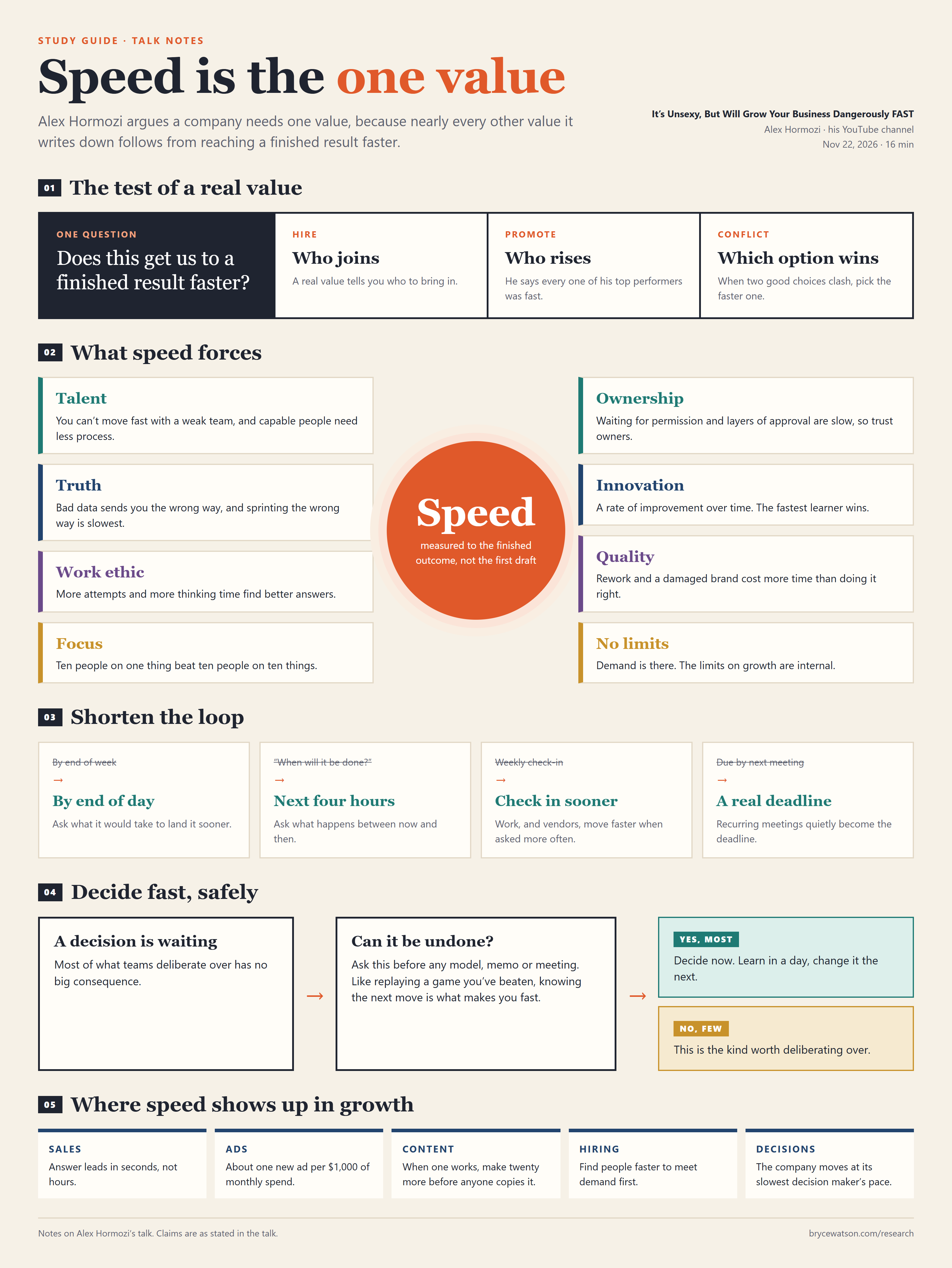
- Most companies list five to seven values nobody can recite or hires by, so keep one you actually use: speed.
- Solving for speed forces the other values: capable hires, honest feedback, focus on fewer things, and owners who don't wait for permission.
- Measure speed to the finished outcome, not the first draft, because rework and a damaged reputation are the slowest things there are.
- Shorten the asks and the check-ins: end of day instead of end of week, and no deadline that just means the next meeting.
- Most decisions people deliberate over can be reversed, so make them fast and fix the few that turn out wrong.
- A real value tells you who to hire, who to promote and what to do when two options conflict.
Alex Hormozi argues a company needs one value, speed, because nearly every other value it might write down (talent, honesty, focus, ownership, quality) follows from getting to a finished result faster. These are my notes on his 16-minute talk, which works through why each one follows and ends with a test for any decision: does this make us faster? He frames it as something to send to your team, and he says he’s sending it to his own.
He introduces himself through his record: he says he sold his last company for $46.2 million and now runs a portfolio of companies doing more than $250 million a year in revenue. Figures on this page are as he gives them in the talk.
One value instead of seven
His starting point is that most companies have a handful of aspirational values that nobody can recite and nobody hires or fires by. He says his company had written values too, and people followed them to different degrees, but every one of his top performers shared one trait: they were fast. He took that as the trait underneath the others.
His test for whether a value is real has three parts. Does it tell you who to hire? Who to promote? And what to do when two good options conflict? Speed answers all three, so he uses it as the single question for people, products, marketing and decisions.
What speed forces
He walks through the values companies usually write down and argues each one falls out of solving for speed:
- Talent. You can’t move fast with a weak team, and capable people need less process and oversight. He goes as far as saying a business grows faster from removing slow performers than from adding strong ones.
- Truth. Bad data and polite feedback send you the wrong way, and sprinting in the wrong direction is the slowest thing you can do. With a clear goal, fast feedback and a long horizon, he says winning becomes a question of when rather than if.
- Work ethic. More hours and more attempts mean more surface area on a problem, and deeper thinking finds better answers.
- Focus. Ten people on one thing beat ten people on ten things. A company only has so much capacity, so speed forces you to say no. He blames the spread on avoiding hard calls and deciding by committee, which he says the founder has to fight as the company grows.
- Ownership. Waiting for permission, escalating everything and re-checking work are all slow, so speed pushes you to hire people you trust and let them own outcomes. He’s skeptical of heavy standard operating procedures for marketing, sales and delivery, which change too fast, and says each extra layer of management filters the information going up and coming back down.
Speed to the finished result
The objection he expects is that speed costs quality. His answer is to measure speed to the finished outcome rather than the first draft. Shipping something poor slows you down later: it hurts the brand, slows word of mouth, and someone has to redo it. Counted that way, quality is part of speed.
He treats innovation the same way, as a rate of improvement over time rather than a trait. The fastest learner wins over a long enough period, and an improvement that takes a century isn’t an innovation by the time it arrives. He points to Anthropic shipping new products and features constantly despite its size.
He considered calling the value “long-term speed” and decided against it. People who are slow by habit, he says, would hide behind “long-term” to justify more deliberation. He’d rather someone try, fail and fix it quickly than deliberate.
Deadlines and cadence
His practical tactics are about shortening the loop:
- Ask how long something will take, then ask what the person is doing in the next four hours.
- Ask what it would take to have it by the end of the day instead of the end of the week. He says moving from end of week to end of day is how a team moves several times faster.
- Be wary of recurring meetings, because people quietly treat the next meeting as their deadline.
- Check in more often. He says someone checked on hourly finishes far sooner than someone checked on weekly, and the same holds for vendors: call back an hour after asking for a quote.
His example of a decision that shouldn’t take a week: if the team just tried it, they’d know in a day whether it worked, and if it didn’t, they could change it the next day. Both outcomes are settled within 48 hours.
Where speed shows up in growth
He says the limits on a business are internal: demand is there, and either you grow to meet it or competitors will. His examples, as he tells them:
- Sales. Responding to leads in seconds rather than in 40 hours can bring four to five times the sales.
- Paid ads. Most small businesses run too few ads; he suggests about one new ad per thousand dollars of monthly ad spend, and more in local markets where ads wear out faster.
- Organic content. When something works, make twenty more of it before anyone copies you. You use up the idea first, and the copier looks like the copycat.
- Hiring. Finding people faster lets you take opportunities and scale a department to meet demand before others can.
- Decisions. The business moves at the speed of its slowest decision maker, and he names slow replies on Slack as one of the small bottlenecks that add up.
Reversible decisions
His analogy is replaying a video game you’ve already beaten. Your character moves at the same speed as the first time, but knowing what to do lets you finish several times faster. He wants a company to approximate that by making most decisions almost instantly.
The reason that’s safe, he says, is that most decisions people deliberate over aren’t irreversible. Ask whether a decision can be undone. Even where getting it wrong has a cost, the occasional loss is small next to what being first or fastest returns. He adds that being first often beats being better, because a later product has to be much better to overcome the cost of switching, and he gives Uber and Lyft as the example. He closes by saying he’d accept nine in ten fast, decentralized decisions being right, and he credits Andy Grove’s “only the paranoid survive” for the habit of assuming a faster competitor is always just starting.
How to try it
To apply the talk to a team of your own, his points reduce to a short checklist:
- Write down the one question: does this get us to a finished result faster?
- Use it to settle the next hire, the next promotion and the next disagreement between two options.
- For each open piece of work, ask what happens in the next four hours and whether it could land today.
- Replace one recurring meeting’s deadline with a check-in that happens sooner.
- Before deliberating on a decision, ask whether it can be reversed; if it can, decide now.
Key terms
- Single organizing principle
- One value that every decision is tested against: does this make us faster?
- Macro speed
- Speed measured to the finished, working result, which counts rework against you.
- Models, memos and meetings
- His three ways people look busy while delaying a decision; useful sometimes, but not the work that makes money.
- Cadence of communication
- How often you check in on a piece of work; he says checking in more often gets it done sooner.
- Irreversible decision
- The kind worth deliberating over; he says most decisions aren't one.
Quotes from the talk
Money loves speed. Wealth loves time. Poverty loves indecision.
Volume negates luck.
A lot of times first does beat better.
Study guide
The same notes as one tall page, made to print or keep. The preview shows the top; open it for the whole thing.