Key ideas
- A goal is about the outcome, which you can't fully control. A constraint is about the process, which you can.
- When the path to a result isn't obvious, a tighter constraint helps more than a bigger goal.
- A constraint is a decision made in advance: a no you don't have to argue with yourself about later.
- Taking resources away pushes people to repurpose and recombine what they already have.
- First ideas are rarely the best ones, so a constraint that makes you generate more of them pays off.
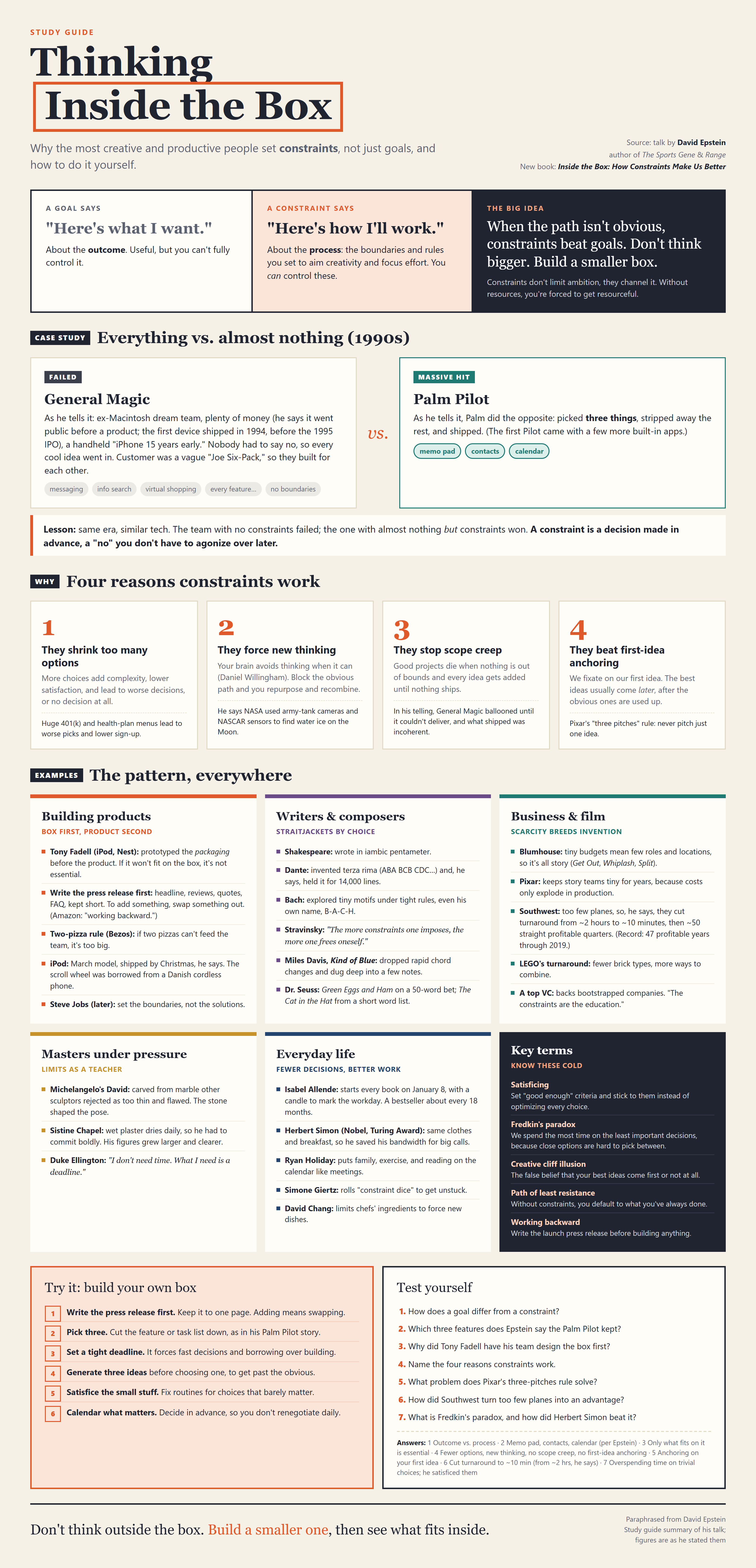
David Epstein’s argument fits in one line: when you don’t know the path, set limits on how you’ll work instead of a bigger target for what you’ll get. A goal names an outcome you can’t fully control. A constraint is a decision you make in advance about the process, and that part you do control. These are my notes on his 25-minute talk for his new book, Inside the Box, with his four reasons it works and the examples he uses.
General Magic and the Palm Pilot
His anchor story is two handheld computers from the 1990s. As he tells it, General Magic had a team of former Macintosh engineers, more money than it needed, and a vision he describes as an iPhone fifteen years early. He says Goldman Sachs took it public before it had a product (the record differs a little: Sony’s Magic Link, the first device running its software, shipped in 1994, months before the February 1995 IPO). Nobody had to say no to anything, so every good idea went in, and the customer was too vague to push back. It failed.
The Palm Pilot, in his telling, did the opposite. He says it picked three things (a memo pad, contacts and a calendar), cut everything else, and shipped. (The first Pilot actually came with a few more built-in apps, including a to-do list.) It was a hit. His point: same era, similar technology, and the team with no limits failed while the team that cut the most shipped a hit.
Why constraints work
Epstein gives four reasons.
- They cut the number of options. Past a point, more choices make decisions worse, or stop them happening at all. His example is retirement and health plans with long menus, which he says lead to worse picks and fewer people signing up.
- They force new thinking. Your brain avoids hard thinking when an easy path exists, a point he credits to the psychologist Daniel Willingham. Block the obvious path and people start repurposing. NASA, he says, used army tank cameras and NASCAR sensors to look for water ice on the Moon.
- They stop scope creep. When nothing is out of bounds, every idea gets added until nothing ships. That’s his reading of what happened to General Magic.
- They beat anchoring on your first idea. We fixate on the first idea we have, but the better ones tend to come later. Pixar’s rule of never pitching just one idea is his example.
The same pattern elsewhere
Most of the talk is examples. These are the ones that stuck with me, grouped roughly the way the study guide groups them. They’re his accounts, and I haven’t checked them.
- Products. Tony Fadell, who led the iPod and later founded Nest, had his team design the packaging before the product: if a feature couldn’t earn a place on the box, it wasn’t essential. Amazon writes the press release first. Jeff Bezos’s two-pizza rule caps team size. The iPod, he says, went from a March start to a Christmas launch, with a scroll wheel borrowed from a Danish cordless phone.
- Writing and music. Shakespeare wrote in iambic pentameter. Dante invented terza rima and, he says, held it for about 14,000 lines. Bach built pieces from tiny motifs, including the letters of his own name. Miles Davis made Kind of Blue by dropping fast chord changes and staying with a few notes. Dr. Seuss wrote Green Eggs and Ham on a bet to use only 50 different words.
- Business and film. Blumhouse keeps budgets so small that its films have few roles and locations, so everything rides on the story. Pixar keeps story teams tiny for years, because costs only explode in production. Southwest had too few planes, so, he says, it cut the time to turn one around at the gate from about two hours to about ten minutes, and that started roughly 50 straight profitable quarters, up to the pandemic. (The record is usually told in years: 47 straight profitable years through 2019.)
- Working under limits. Michelangelo carved David from a block other sculptors had rejected as too thin, and the stone shaped the pose. On the Sistine Chapel the plaster dried every day, so he had to commit, and his figures got bigger and clearer.
- Daily life. Isabel Allende starts every book on January 8. Herbert Simon, who won a Nobel and a Turing Award, wore the same few outfits, ate the same breakfast and settled for good-enough answers outside his work, he says, so his attention went to the decisions that mattered. Ryan Holiday puts family, exercise and reading on his calendar like meetings. Simone Giertz rolls dice to pick a constraint when she’s stuck. The chef David Chang limits his cooks’ ingredients to force new dishes.
How to try it
The study guide ends with six ways to put the idea to work, all drawn from his examples:
- Write the one-page press release before you build, so adding something means swapping something out.
- Pick three features or tasks, as he says the Palm Pilot did, and cut the rest.
- Set a tight deadline, which forces quick decisions and borrowing over building.
- Come up with three ideas before choosing one.
- Set a good-enough bar for small choices and use fixed routines.
- Put what matters on the calendar, so you decide once instead of every day.
His closing point, paraphrased: don’t try to think outside the box. Build a smaller one and see what fits inside it.
Key terms
- Satisficing
- Setting a good-enough bar for a choice and stopping once something clears it, instead of optimizing every decision.
- Fredkin's paradox
- The closer two options are, the longer we agonize over them, even though the choice matters least.
- Creative cliff illusion
- The mistaken belief that your best ideas come first, and that you've run dry once they slow down.
- Path of least resistance
- What you do by default when nothing blocks it, which is usually what you've always done.
- Working backward
- Amazon's habit of writing the launch press release before building anything, so the release sets the scope.
Quotes from the talk
The more constraints one imposes, the more one frees oneself.
I don't need time. What I need is a deadline.
Study guide
The same notes as one tall page, made to print or keep. The preview shows the top; open it for the whole thing.