Key ideas
- Value is desirability plus scarcity: what people get from a thing, and how hard that is to get anywhere else.
- Value is what the customer gets, not what the product is or how it's made. It can be material, emotional or both.
- Solving a problem is one way to create value. Identity, pleasure, belonging and meaning are others, and they need no problem.
- What's scarce and what's wanted keep changing, so aim for new value. New is harder to fool yourself about than unique.
- A different process, the category's basic promise, a bolted-on selling point, good intentions and better wording aren't value.
- Once you've found the value, the product is how it's made and the brand is how it's told. Nothing else belongs in the business.
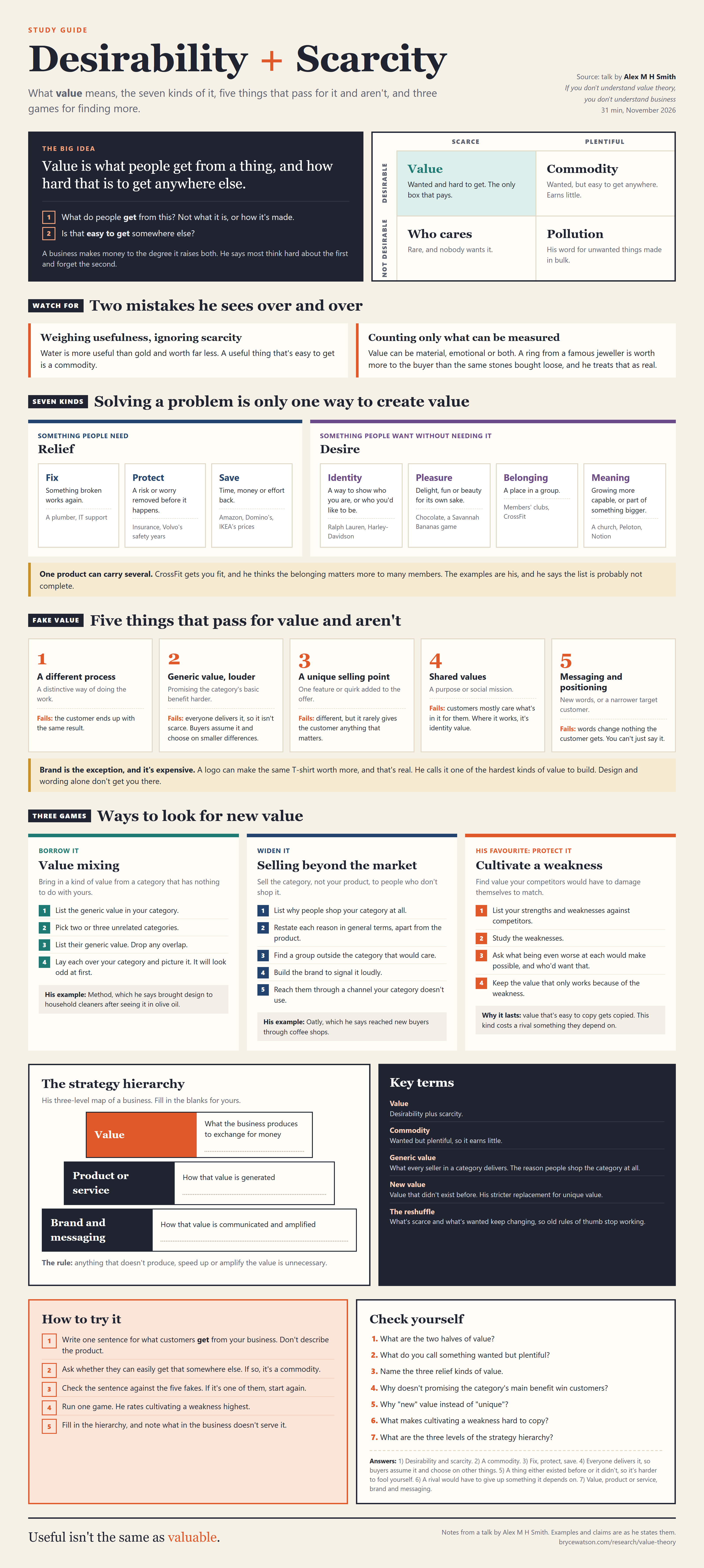
Alex M H Smith defines value as desirability plus scarcity: what people get from a thing, and how hard that is to get anywhere else. A business makes money to the degree it raises both, and he says most businesses think hard about the first half and forget the second. These are my notes on his 31-minute video: the seven kinds of value he lists, the five things that pass for value and aren’t, his three games for finding new value, and the one-page hierarchy he uses to check that a business is built around it.
The definition
He puts desirability and scarcity on a two-by-two grid. Only one box pays.
| Scarce | Plentiful | |
|---|---|---|
| Desirable | Value | Commodity |
| Not desirable | Who cares | Pollution, his word for unwanted things made in bulk |
His simplest test is two questions. What do people get from this product or service? Is that easy to get somewhere else? The first answer is the value, and it isn’t the same thing as the product.
He sees two mistakes over and over:
- Weighing usefulness and ignoring scarcity. Water is more useful than gold and worth far less. A useful thing that’s easy to get is a commodity.
- Counting only what can be measured. His example is an engagement ring. Loose stones bought direct would give four to five times the material for the price, by his telling, yet a ring from a famous jeweller is worth more to the buyer, and he treats that as real value, not a trick.
Seven kinds of value
He says the purpose of a business is to create value, not to solve problems. Solving a problem is one legitimate way to do that, and plenty of large businesses solve no problem at all. He sorts the ways into two groups: relief, which is something people need, and desire, which is something they want without needing it. He says the list is probably not complete.
| Group | Kind | What the customer gets | His examples |
|---|---|---|---|
| Relief | Fix | Something broken works again | A plumber, IT support |
| Relief | Protect | A risk or worry removed before it happens | Insurance, Volvo’s safety years |
| Relief | Save | Time, money or effort back | Amazon, Domino’s, IKEA’s prices |
| Desire | Identity | A way to show who you are, or who you’d like to be | Ralph Lauren, Harley-Davidson |
| Desire | Pleasure | Delight, fun or beauty for its own sake | A bar of chocolate, a Savannah Bananas game |
| Desire | Belonging | A place in a group | Members’ clubs, CrossFit |
| Desire | Meaning | Growing more capable, or being part of something bigger | A church, Peloton, Notion |
One product can carry several. CrossFit gets you fit, and he thinks the belonging matters more to many members.
Why value keeps moving
For a long time, he says, what was valuable stayed put, so people could make money by repeating what already worked without ever defining value. That has stopped being safe. Things that were scarce have become plentiful, some things that were wanted aren’t any more, and a few things have moved the other way. He calls this the reshuffle, and his answer is to work out what’s valuable from the definition instead of from habit.
He also changes one word. His book argued for unique value. In practice, he says, people used unique to mean “we’re good and our competitors aren’t”, so he now asks for new value. A thing either existed before or it didn’t, which makes it harder to fool yourself. It also makes every business an innovator, and he cites Peter Drucker’s line that the two core activities of a business are innovation and marketing.
Five kinds of fake value
These are the ways he sees businesses convince themselves they’re creating value. Each fails one of the two tests in the definition.
| Fake value | What it is | Why it isn’t value |
|---|---|---|
| Differentiated process | A distinctive way of doing the work | Value is what the customer ends up with. A different route to the same result gives them nothing new |
| Forceful generic value | Promising the category’s basic benefit harder, because research says customers care most about it | Everyone in the category delivers it, so it isn’t scarce. Customers assume it and choose on smaller differences |
| The unique selling point | A single feature or quirk added to the offer | It’s different, but one bolted-on difference rarely gives the customer anything that matters. Real value shapes the whole business |
| Shared values | A company’s purpose or social mission | Customers mostly care what’s in it for them. Where purpose does work, as he says it does for Patagonia, it’s because buyers use the brand to say something about themselves, which is identity value |
| Messaging and positioning | New words, or a narrower target customer | Words alone change nothing the customer gets. Narrowing your audience helps your own sales effort without giving that audience more |
He’s careful about brand. A logo can make the same T-shirt worth more, and that’s real. But he calls a brand like that one of the hardest and most expensive kinds of value to build, and good design and wording don’t get you there.
Three games for finding new value
He says there’s no step-by-step method for finding new value, because a method everyone could follow would stop producing anything scarce. The games are ways to push your thinking, and each ends in an idea to test.
Value mixing. Borrow a kind of value from a category that has nothing to do with yours. His example is the cleaning brand Method, which he says brought design to household cleaners after seeing it in olive oil.
- List the generic value in your category.
- Pick two or three unrelated categories.
- List their generic value, and drop anything that overlaps with yours.
- Lay each one over your category and picture what it would look like. He says it will look odd at first, and the idea is usually a level below the first picture.
Selling beyond the market. Sell the category, not your product, to people who don’t shop it. His example is Oatly, which he says ignored existing oat milk buyers and reached new ones through coffee shops.
- List why people shop your category at all.
- Restate each reason in general terms, detached from the product. For oat milk, lower emissions.
- Find a group that doesn’t buy the category but would care about that general thing.
- Build the brand to signal it loudly.
- Reach that group through a channel the rest of your category doesn’t use.
Cultivate a weakness. This is his favourite, because value that’s easy to copy doesn’t last. Look for value your competitors would have to damage themselves to match.
- List your strengths and weaknesses against competitors.
- Study the weaknesses.
- Ask what would become possible if you were even worse at each one, and what kind of customer would want that.
- Keep the value that only works because of the weakness.
The strategy hierarchy
Once you’ve found a kind of value that’s wanted and scarce, he says producing it is the whole job of the business. He draws it as three levels.
| Level | What it is |
|---|---|
| Value | What the business produces to exchange for money |
| Product or service | How that value is generated |
| Brand and messaging | How that value is communicated and amplified |
Anything in the business that doesn’t produce, speed up or amplify the value is unnecessary. He says being able to fill in the three levels cleanly is the test of a clear strategy, and that almost no business he’s met can do it.
How to try it
- Write one sentence for what customers get from your business. Don’t describe the product.
- Ask whether they can easily get that somewhere else. If they can, you have a commodity, and making it better won’t change that.
- Check your answer against the five fakes. If it’s a process, the category’s basic promise, one feature, a mission or a choice of words, start again.
- Run one game. Cultivating a weakness is the one he rates highest, since what it finds is hard to copy.
- Fill in the hierarchy for the idea, and note what in the business doesn’t serve it.
Key terms
- Value
- Desirability plus scarcity. Something people want that's hard to get elsewhere.
- Commodity
- Something wanted but plentiful, so it earns little.
- Relief value
- Value from giving people something they need: fixing, protecting or saving.
- Desire value
- Value from giving people something they want without needing it: identity, pleasure, belonging or meaning.
- Generic value
- The basic thing every seller in a category delivers, and the reason people shop the category at all.
- New value
- Value that didn't exist before. His stricter replacement for unique value.
- Fake value
- Something a business counts as value that gives the customer nothing scarce.
- Strategy hierarchy
- His three-level map of a business: the value, the product or service that produces it, and the brand that communicates it.
Quotes from the talk
Utility does not automatically translate to value.
Study guide
The same notes as one tall page, made to print or keep. The preview shows the top; open it for the whole thing.