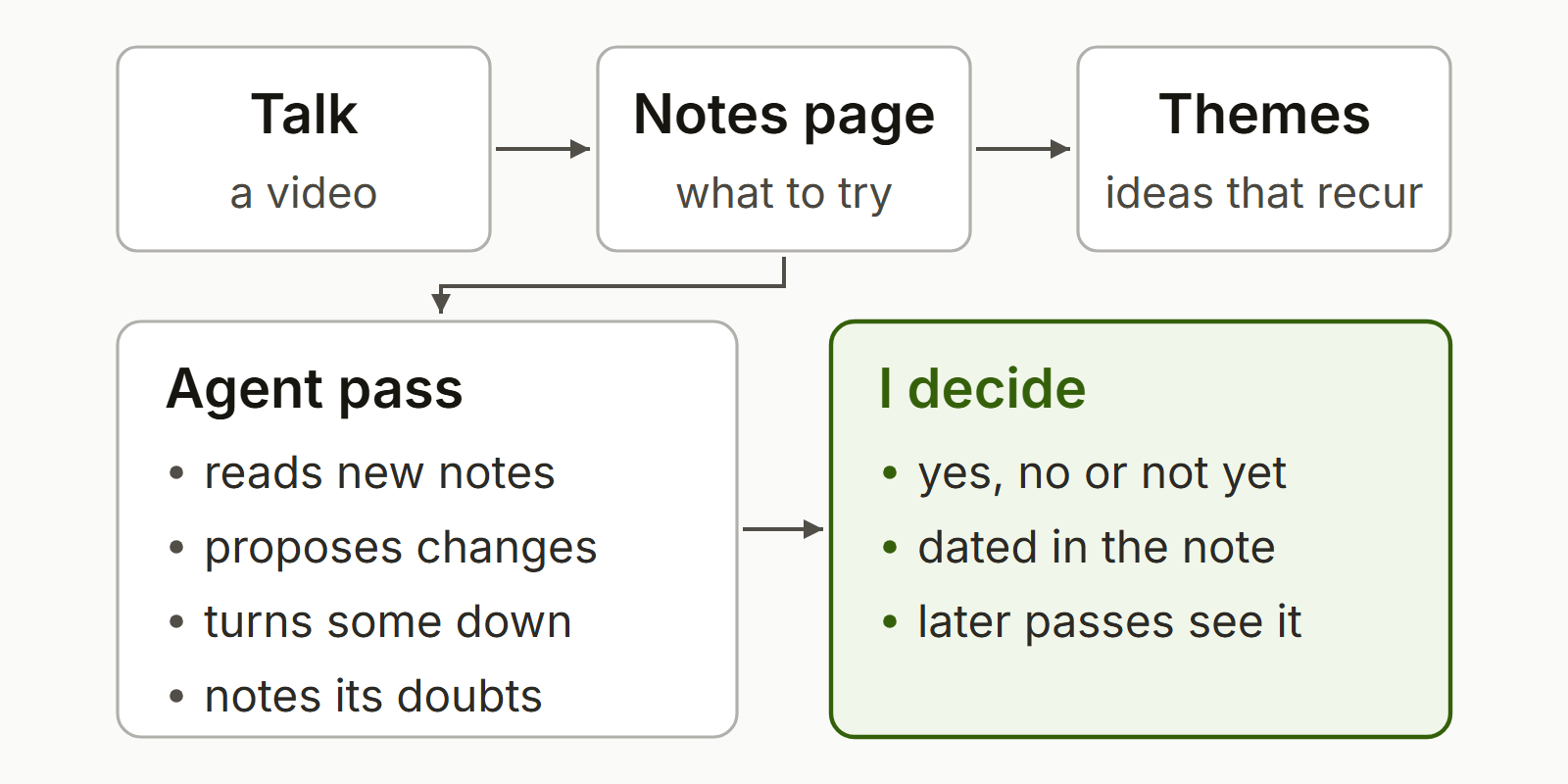
Since October 21 I’ve turned 27 talks into notes on this site. On their own they’d be a reading list. The useful part is what happens next: I ask the agents that run my consulting business to read the newest notes and tell me what applies. That has changed how I’ll price a full job, which numbers I count when bidding for work, and what goes into the one standard path I sell. It also tells me, often, to leave an idea alone.
The business is Watson Standard, my software consulting practice. The agents are Claude Code sessions working in its private repository, which holds its plans, offers and a running record of what I’ve decided. The notes are public, at /research.
From a talk to a notes page
I watch a lot of talks and interviews on YouTube: people who run consulting practices, people who build with AI agents, and the odd health talk. When one is worth keeping, I hand the transcript to a Claude Code session in this site’s repository. It follows a written skill (a set of standing instructions) to turn the talk into a notes page:
- It finds and cites the real source rather than trusting the transcript, which often mangles names.
- Where it can, it checks the talk’s figures against other sources. 13 of the 27 entries carry that fact-checked mark [measured Nov 23, 2026, the entries’ frontmatter].
- It writes the entry as a reference: what the speaker said, the numbers, and a short practical close, often headed “How to try it”.
- It adds the entry to any theme it backs (more on themes below).
Each page goes live through a pull request I approve. The practical close is the part that matters for the rest of this post, because it’s what a business can act on. The first entries went up on October 21 and the most recent on November 22 [measured Nov 23, 2026, the entries’ dates]. I call all 27 talks here, as the site’s records do, though a few are interviews or lessons from a course.
What 27 talks have in common
Grouping the notes made them easier for me to use. The /research page opens with themes: ideas that turn up in more than one talk, each listing the entries behind it. A test fails the site’s build if a theme cites fewer than two entries. The health theme is there because the page holds talks I keep for myself, not only business ones.
| Theme | Entries |
|---|---|
| Doing got cheap, deciding didn’t | 10 |
| You can automate what you can check cheaply | 6 |
| Decide the rule in advance | 6 |
| The hard part is where the skill comes from | 4 |
| You get paid for what’s hard to get elsewhere | 4 |
| In consulting, trust comes before reach | 3 |
| Copy a proven method before improving on it | 3 |
| Gut bacteria, fiber and your health | 2 |
[measured Nov 23, 2026, the site’s theme list. An entry can sit in more than one theme. 26 of the 27 sit in at least one.]
The biggest theme is the useful one. Ten talks from seven people (four of them Nick Saraev’s), including engineers, a writer, a company founder and consultants, make closely related points: AI made producing work cheap, and the scarce part is now deciding what to make and knowing whether it’s right. Two of them, read with a few other notes on November 11, before I’d grouped anything, led to a decision: every first look (a short paid code review) and every fix job will end with a plain list of what “safe” means for that app, plus checks the client’s own tools can keep running. The later talks in the theme backed that decision rather than making a new one. I treat the agreement as a reason to try something, not proof it’ll work. The grouping is my judgment, not a count, so it can only be as fair as my reading of each talk.
Asking the business to read them
The step that turns notes into proposals is a question I type into a Watson Standard session. I call each run of it a pass. The first, on November 11, was:
Look over the latest research in brycewatson.com and see how we can apply any lessons to our business.
The session reads the published version of this site’s notes, fetched fresh that day, and writes a dated planning note in the business’s repository. The first pass read the three newest notes in full and the older ones by their key ideas and practical close. The planning notes mostly have the same parts:
- What was read, as a table of entries, with a column saying whether each one bears on the business.
- Lessons, each covering what the notes say and what it means for the business (labelled as inference, not measurement), usually alongside what the business already does.
- The change proposed, in a few lines.
- Turned down, with the reason for each idea not taken.
- How this could be wrong.
Then I answer with a word or a sentence, and the note records it with the date. Some lessons I park for later, and the note says that too. On November 14 my answer was that I don’t want a large catalogue of offerings, “more of a standard pattern that most clients will follow.” On November 15 it was “Fold evals in”, meaning add checks on whether an AI feature’s answers are right.
There have been three passes so far, on November 11, 14 and 15. A fourth worked through one talk in depth over November 19 and 20. Before that, I applied single talks as they came up.
What changed
These are the changes I can trace from a talk, through my notes, to a dated decision in the business’s records. Each one is a change to how the business works, or in one case a method used once, not a result.
A few of the business’s own terms appear in the table. Its standard path is the sequence the business offers: a free written read of someone’s situation, a short paid review of their code called a first look, then fixes, then a monthly plan. The idea rubric is the scoring sheet the business uses to rank new business ideas.
| Talk | What the business changed | When |
|---|---|---|
| David Epstein, on constraints | Picked three things to focus on, and parked everything else by name with the date or signal that reopens it | Oct 27 |
| Russell Raath, on Hormozi’s consulting advice | The log of proposals sent now also counts conversations that build trust, because volume alone doesn’t say whether proposals are working | Oct 27 |
| Copying what works, with a second startup talk | The idea rubric stopped giving its top mark to a market nobody serves, and rewards a proven paid model instead | Oct 21 |
| Laurie Voss, on evals for agents | When an app under review has an AI feature, the first look now checks whether anything tests its answers, not only whether it can be attacked, and the later stages are set to add those checks | Nov 15 |
| Nick Saraev, Clear Thinking Course | Used once: a pre-mortem that imagines it’s three months later and the job failed, then lists why | Nov 15 |
| Russell Raath, on sizing a practice | New wording for asking for introductions, a plain answer at the top of a first look’s written notes, a rule for pricing the full job, and questions to answer before taking one | Nov 20 |
[measured Nov 23, 2026, the dated decision lines in Watson Standard’s planning notes, proposal log and client template, which are private.]
The Epstein one shows the pattern most plainly. In late October the business had about two dozen open items on its list. His point is that when the path isn’t clear, a limit on how you work beats a bigger goal. The planning note states it, then picks three things to keep and lists everything parked.
What I turned down
Each of the three passes has a section for ideas not taken, and none has been empty. A few examples:
- Re-contacting past leads, from Codie Sanchez’s test of five AI bots. Her strongest claim is that people who asked for a quote and didn’t buy are the cheapest place to point an agent. I turned it down because the business sends one note per person and no reminders, including to people who once asked for a quote.
- A free self-check prompt for founders, from Karpathy’s habits. It could work as a way for people to find the business, but it gives away the automated half of a review without the judgment half.
- Saraev’s offload rule: hand work off when your hours at your best rate clearly beat the price plus the time spent supervising. It’s sound, but it doesn’t fit how the business runs now.
Turned-down items like these are some evidence against an obvious worry, that an agent asked “what applies?” will find that everything does. A talk is one person’s experience in their situation, and much of what I watch is interesting without applying to my business.
Where this breaks down
A pass can’t tell you whether a change worked. It proposes changes and records the ones you accept. Knowing whether one helped takes a measure you set up separately, such as a count you check a few weeks later.
Talks are a skewed source. Some people who give talks about business and AI sell something close to what they recommend, and notes on their talk carry that slant. It’s worth checking what a speaker sells before adopting their advice. One pass flagged that a speaker works for the company that makes the tracing tool his workshop uses, and noted that none of the steps depended on it.
Unchecked notes carry the talk’s errors. A note records what the speaker said. Unless someone checks the figures against other sources, a wrong number in the talk becomes a wrong number in your plan. 13 of my 27 have been checked that way.
An agent asked “what applies?” tends to find something. That’s why the note asks for what to turn down and why, and why the decision stays with a person. The passes propose; I decide what’s adopted.
Trying it yourself
You don’t need a public site for this. You need three things.
Notes in a place your agent can read. A folder of Markdown files in a repository works, and the agent can read it from another project on the same machine. Give each note a source link and a short practical close, because that’s the part a later pass acts on.
A question you ask on purpose. I run a pass when there are new notes worth reading against the business; it isn’t on a schedule. Ask for the answer in a fixed shape, so passes can be compared. This is a version you could start from, not the exact wording my passes used:
Read the notes added since the last pass and tell me what applies to this project.
Write a dated note with: what was read (and whether it bears on this project), each
lesson (what the notes say, what it means here, what we already do), the change
proposed, what you'd turn down and why, and how this could be wrong.
A dated answer, written down. Mine go in the note, beside the lesson they answer:
Decided Nov 15, 2026: one path, not a new offer. Bryce: "Fold evals in."That record lets a later pass see that an idea was already decided, and why, without asking me again.
Themes start to help once a few notes overlap. My rule of thumb is to wait until you can see two notes making the same point; the site’s own rule is that a theme needs at least two entries behind it.